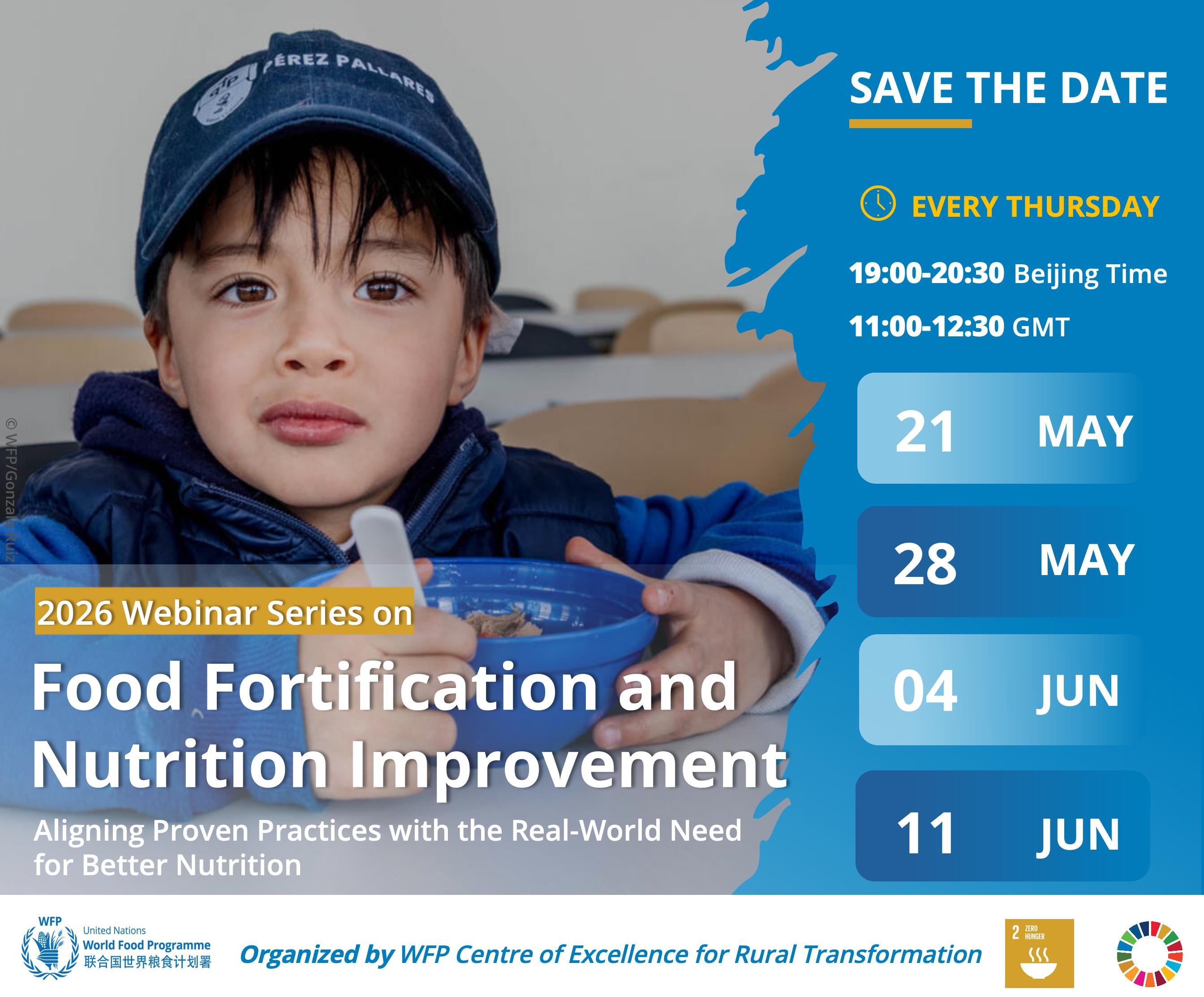
Please kindly find the REGISTRATION link: https://wfp-org-conference.zoom.us/webinar/register/WN_5p1vYqMoTvGlMeUw-XsSBw
Background
According to the 2026 Global Report on Food Crises (GRFC), acute food insecurity remained widespread across crisis-affected countries and territories in 2025, with 22.9 percent of the analysed population- 266 million people in 47 countries/territories- facing high levels of acute food insecurity, a marginal increase from 22.7 percent in 2024. Beyond inadequate caloric intake, hunger also drives widespread micronutrient deficiencies, known as ‘hidden hunger’. Deficiency of micronutrients can be linked to anemia, adverse birth outcomes, night blindness, increased risk of mortality in children and pregnant women, increased risk of osteoporosis in adults and rickets in children, reduced resistance to infectious diseases, fatigue, and impaired cognitive function.
Vitamin and mineral deficiencies affect around 2 billion people worldwide including one in two pre-school-aged children and two in three women of reproductive age and have been identified as a global health issue in many low- and middle-income countries. These deficiencies carry substantial social and economic consequences, losing up to 5% of their GDP due to the reduced productivity, poor health, and impaired cognitive development associated with micronutrient deficiencies.
Fortification is an evidence-informed intervention that contributes to the prevention, reduction and control of micronutrient deficiencies. Fortifying widely consumed foods, such as flour, rice, edible oil, and salt, provides a scalable, equitable, and sustainable strategy to increase micronutrient intake without requiring changes in dietary habits. Food fortification is highlighted in the WFP Strategic Plan (2026–2029) as a key component of WFP’s commitment to improving nutrition outcomes and supporting governments to scale sustainable solutions to malnutrition. WFP has already made substantial progress: in 2024, WFP supported capacity strengthening for fortification across 54 countries in policy development, increasing demand and improving supply. WFP has also committed to increasing the proportion of fortified wheat flour, maize meal and rice distributed in its programmes from 60 percent in 2020 to 80 percent in 2025, underscoring its long‑term institutional commitment to fortification as a pathway to better nutrition.
Food fortification is also an important work of WFP Centre of Excellence for Rural Transformation (WFP China COE). From 2019-2023, WFP has conducted a pilot project of zinc-rich potatoes for smallholder farmers in Gansu Province, China, which improved smallholders’ health by increasing their consumption of balanced diet with fortified crop and providing nutrition knowledge education. In 2025, in collaboration with WFP Côte d’Ivoire Country Office, WFP China COE facilitated a South-South rice fortification study tour in China sharing practical insights from China’s experience in rice nutritional fortification to support the implementation of Côte d’Ivoire’s National Multisectoral Nutrition Plan.
China’s food fortification started from the universal salt iodization in 1993, and broader large scale fortification of staple foods began in the early 2000s. The designated food vehicles included salt, wheat flour, edible oil, soy sauce, and complementary foods for children, forming the foundation for population wide micronutrient improvement. Since then, China has progressively issued national and provincial standards for the fortification of wheat flour, edible oil, eggs, and instant cereal powders.
A study conducted by National Institute for Nutrition and Healthof Chinese Center for Disease Control and Prevention and the School of Public Healthof Peking Universityrevealed that remarkable progress in the reduction of child undernutrition, thanks to a large programme to alleviate poverty and to improve nutrition in children, including the distribution of micronutrient supplements. Between 2016 and 2021, the prevalence of anemia among infants aged 6-23 months had decreased by more than half and stunted by more than a third.
China’s fortification progress combines regulatory frameworks, industrial capacity, and public health objectives to expand access to fortified foods and reduce micronutrient deficiencies among vulnerable populations. These experiences and technologies offer important and valuable reference for other developing countries to advance food fortification through South–South and Triangular Cooperation (SSTC).
In addition, WFP ChinaCOE circulated a global survey to learn more field needs on South-South and triangular capacity buildinginitiatives in March 2026. According to the survey result, fortification would be the most popular topic commonly mentioned by respondents in nutrition and school feeding, including principles, industrial process, quality assurance and safety requirements for fortified foods, as well as additional malnutrition prevention measures. It laid a solid foundation for the development of this webinar series.
Objective
Responding to the growing demand from the field for proven, practical and scalable solutions and technologies in food fortification, WFP China COE will organize a webinar series on food fortification and nutrition improvement under the SSTC umbrella from May to June 2026.
The series aims to:
1) Share adaptable, affordable, and applicable technologies, practice, experience and equipment for food fortification and nutrition improvement.
2) Provide a platform for knowledge exchange among developing countries and specialized sectors to explore diverse technical solutions and foster further cooperation.
Organization and Participation
The webinar series will be organized by WFP China COE.
The webinar series is a public, online capacity-building initiative primarily targeting government officials, technical experts, enterprises and other stakeholders who engaged in food fortification in developing countries. Staff from WFP and other international organizations working on relevant topics or with an interest in these subjects are also welcome to participate.
All sessions will offer simultaneous interpretation in Chinese, English, French, and Spanish to ensure inclusive participation. The webinar recordings will be edited and uploaded at the WFP-China South-South Cooperation Knowledge Platform and Cloud School (www.wfpchinacoe.net) as video courses.
A Certificate of Completion will be awarded to participants who attend every session in full. Participants are requested to register with their official full name and a valid email address for certificate issuance. WFP China COE reserves the final authority on all matters concerning certificate eligibility and issuance.
Programme
Four webinar sessions will be held from 19:00-20:30 Beijing Time (11:00-12:30 GMT) on Thursdays from 21 May to 11 June 2026. Each session will feature thematic presentation by guest speakers followed by interactive discussions with participants. A post-session survey will be administered to collect participant feedback and identify priority areas for future capacity building initiatives.
Please refer to the Annex for agenda details.
Annex Tentative Agenda
Agenda
(Tentative)
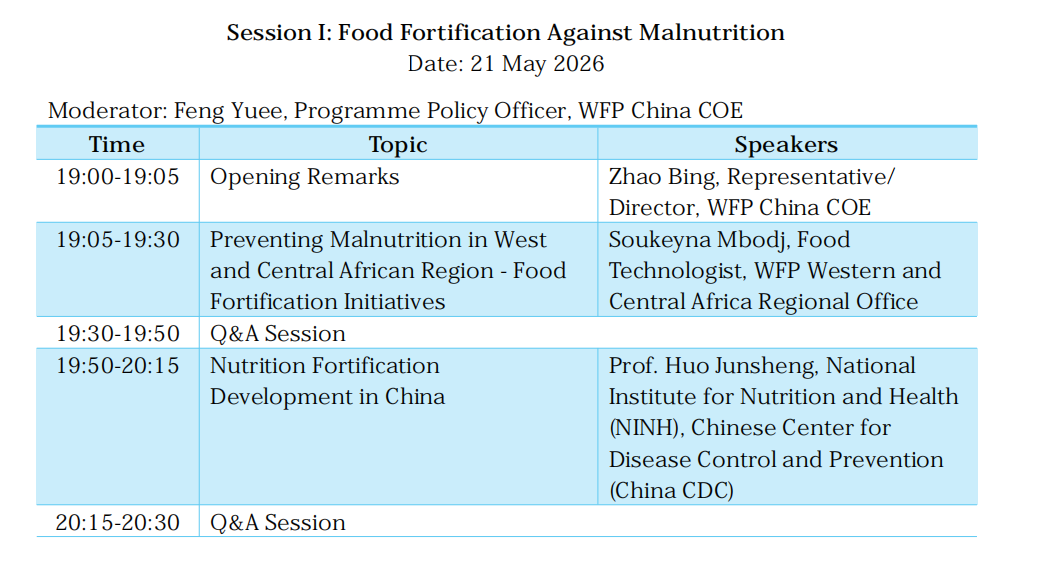
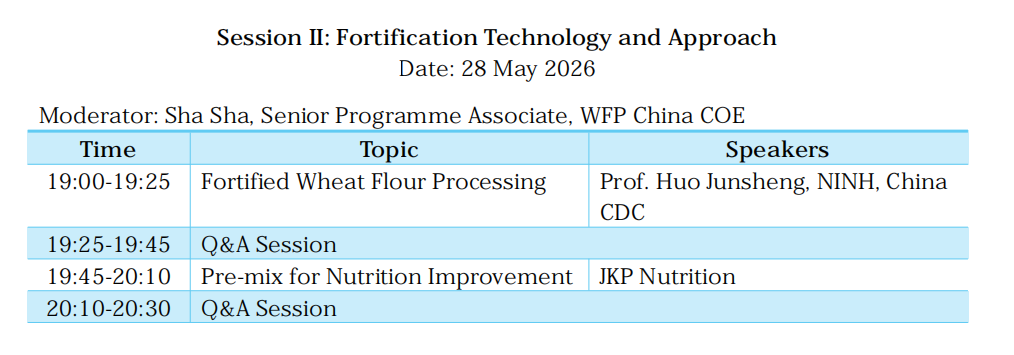
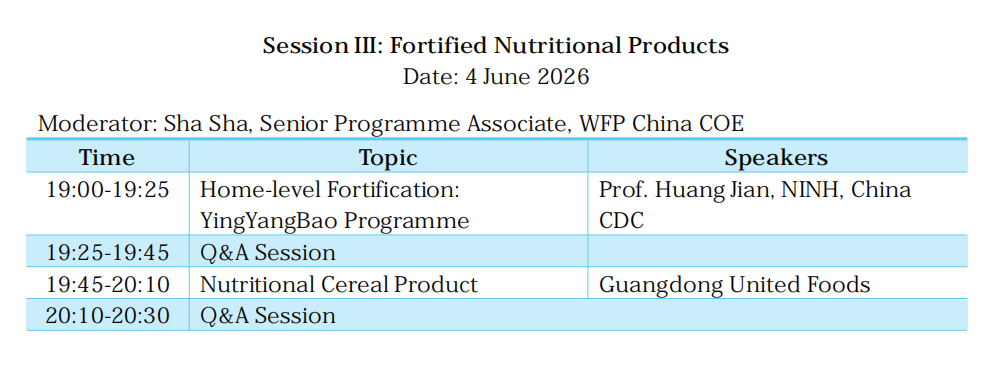
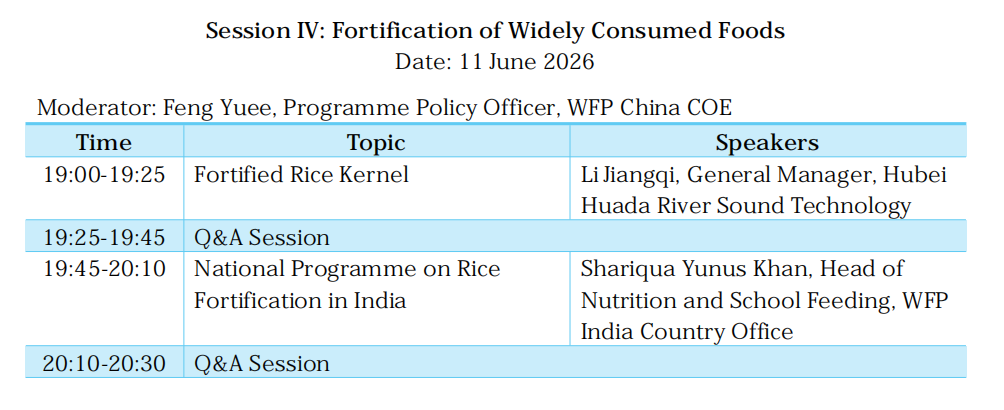
Additional Notes:
· All agenda times are in Beijing Time (GMT+8).
· Participants are advised to join 5–10 minutes early for smooth access.
· For inquiries, contact the focal point at sha.sha@wfp.org