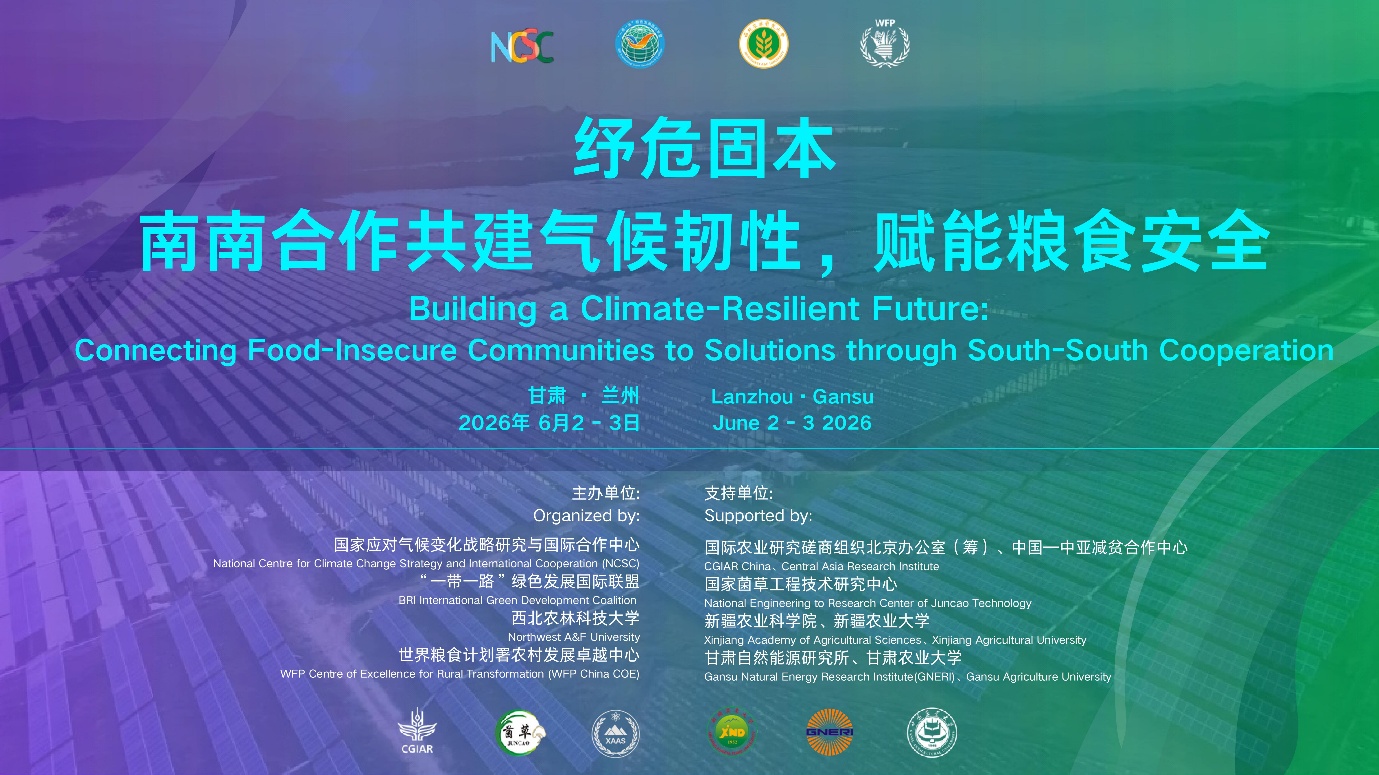
Date: 2-3 June 2026
Venue: Lanzhou, Gansu
Zoom ID: 950 4892 6054
Passcode: 980951
Please click here to register and join the seminar for the ZOOM meeting during 2–3 June 2026.
Background & Challenges
Climate challenges pose an existential threat to global food security, ecosystems, and the livelihoods of smallholder farmers, particularly in arid, semi-arid, and drought-prone regions of the Global South. Weather-related shocks are a primary driver of acute food insecurity for one in three people facing hunger globally. Rising temperatures, erratic rainfall, and land degradation impact the livelihoods and food systems, often inducing recurrent cycles of shock crisis.
• Increasing Vulnerabilities and Humanitarian Needs: Rising temperatures, erratic rainfall, desertification, and extreme weather events are severely undermining the sustainability of food systems, exacerbating hunger, poverty, and displacement. These challenges are demanding more efforts in addressing the increasing humanitarian needs, a core objective of WFP's strategic framework.
• Technological and Capacity Gaps: Limited access to proven and adaptive technologies that effectively enable rural livelihood improvement and smallholder value chain development, hinders the capacity of vulnerable communities and governments to build systemic resilience. Bridging these gaps is essential for transitioning from project-based interventions to sustainable, nationally owned solutions.
• Green Development Imperative: The outcomes of COP30 in Belém, Brazil, sustainable environment for sustainable development, have reinforced the urgency of aligning climate actions. This creates a critical window to advance green development pathways that harmonize ecological health with economic progress. This dialogue is positioned to contribute to this global agenda by showcasing practical models that integrate renewable energy, ecological restoration, and climate-smart agriculture.
WFP envisions a future where healthy and resilient ecosystems underpin the well-being and livelihoods of people living. Over the past years, WFP and partners have restored over 325,000 hectares in Africa, in particular across the Sahel, transforming the lives of 4.2 million people in over 3,000 villages. This progress has improved food availability, nutrition and resilience against economic shocks – reducing the need for humanitarian assistance.
In this context, the WFP Strategic Plan (2026-2029) calls for a more focused, integrated approach: prioritizing lifesaving assistance for the most food-insecure (Strategic Outcome 1) while working to reduce long-term humanitarian needs by strengthening the resilience of communities exposed to recurrent shocks (Strategic Outcome 2).
WFP prioritizes building climate resilience as a core pathway to reducing humanitarian needs. Its programmes, such as Food Assistance for Assets (FFA) and anticipatory action, use food and cash-based assistance to stabilize livelihoods, protect productive assets, and enable communities to invest in climate adaptation. A key strategic enabler is strengthening national systems and capacities (Strategic Outcome 3).
WFP’s China-based Centre of Excellence for Rural Transformation (COE), in line with WFP’s Policy on South-South and Triangular Cooperation, facilitates the exchange and transfer of knowledge, policies, and scalable solutions from China and the global South to other developing countries. The COE acts as a bridge, connecting WFP Country Offices and partner governments with Chinese and regional expertise in areas like ecological agriculture, renewable energy application, and desertification control. By fostering demand-driven SSC, the COE helps translate WFP’s strategic focus into practice, ensuring that food-insecure communities can access relevant resources and local innovations through stronger national and local systems, rather than through WFP’s direct implementation.
This dialogue addresses the critical challenge of operationalizing this strategic shift. While proven, scalable green technologies and practices exist, food-insecure smallholders and vulnerable communities often cannot access them due to capacity, policy, or investment gaps. WFP’s role, as outlined in the Strategic Plan, is increasingly to connect these communities, governments, and partners to the solutions they need, leveraging its operational platform (including food and cash assistance) to enable investments in a more resilient future.
Objectives
This dialogue is strategically designed to strengthen WFP’s capacity as an enabler in the field of climate resilience. Moving beyond theoretical exchange, it will serve as a practical platform to:
1. Integrate Food Security and Assistance: Explicitly explore how climate resilience practices can be strategically linked to or embedded within WFP’s food assistance programmes (e.g., FFA, food assistance, school meals) to enhance their impact, protect assets, and reduce recurrent needs.
2. Foster Actionable Partnerships for Systemic Change: Focus on how WFP, through its COE and Country Offices, can better connect governments and vulnerable communities to the policies, partnerships, and technologies needed for systemic resilience.
Thematic Focus
The dialogue will focus on key themes where linking green innovations with WFP’s core strengths offers the highest value for food-insecure communities:
1. Resilience Policy and National Systems: How national policies can foster an ecosystem where food assistance programmes and resilience-building technologies reinforce each other, including through SSTC.
2. Solar Solutions as Catalysts: Practical applications of solar energy in practice and how they can be integrated with safety nets, asset creation, and local value chains to reduce vulnerability.
3. Ecological Restoration for Livelihoods: Approaches like Juncao technology and integrated farming practice (eg, integrated aqua-systems and solar-solution based systems) for local communities.
4. From Project to Policy: Analysing case studies to understand effective pathways for transitioning from pilot projects to nationally owned, scaled-up policies supporting sustained nationally owned partnerships.
Expected Outcomes
The seminar seeks to promote effective policy dialogue, align with the needs of developing countries, share practical experience in China's green development, integrate appropriate technologies into project proposals, and promote generation of actionable insights for WFP’s work.
• Enhanced Programme Integration: Clearer understanding of how specific green technologies(eg, water catchment, efficient irrigation, integrated watershed management, etc,.) can be linked to food assistance programmes to amplify resilience outcomes for the most food insecure.
• Partnership Pathways: Identification of concrete partnership models and SSC pathways through WFP China COE can connect countries to needed expertise and technologies.
• Strategic Alignment: Synergize China COE' engagement and country operations to ensure alignment with the focused approach of the new Strategic Plan. China COE and COs work as connectors or facilitators in identifying, accessing, and applying relevant South-South Cooperation solutions to enhance resilience programming.
Participants
This policy dialogue aims to convene key stakeholders to facilitate knowledge exchange and partnership under the framework of South-South Cooperation. Target participants are strategically grouped to maximize relevance and impact:
1. From WFP Programme Countries: High-level policymakers, government technical focal points, and national practitioners to ensure solutions are demand-driven and applicable in country contexts. International travel will be self-managed. In-China cost will be covered by WFP China COE.
Embassy colleagues from the above countries are welcome to join the Seminar with cost covered by WFP China COE.
2. From China: Representatives from relevant government authorities, research institutions, and technical implementing partners who can share policy insights, innovative models, and practical expertise emanating from China's development experience.
3. From WFP: WFP colleagues are welcome to join the Seminar in case of facilitation needed to support the government partners. All participation costs, including travel and accommodation, are to be self-managed.
Event arrangement
• Hybrid format with onsite seminar in Lanzhou and Zoom meeting virtually.
• The event will be in English, Chinese, and French. Simultaneous Interpretation will be provided.
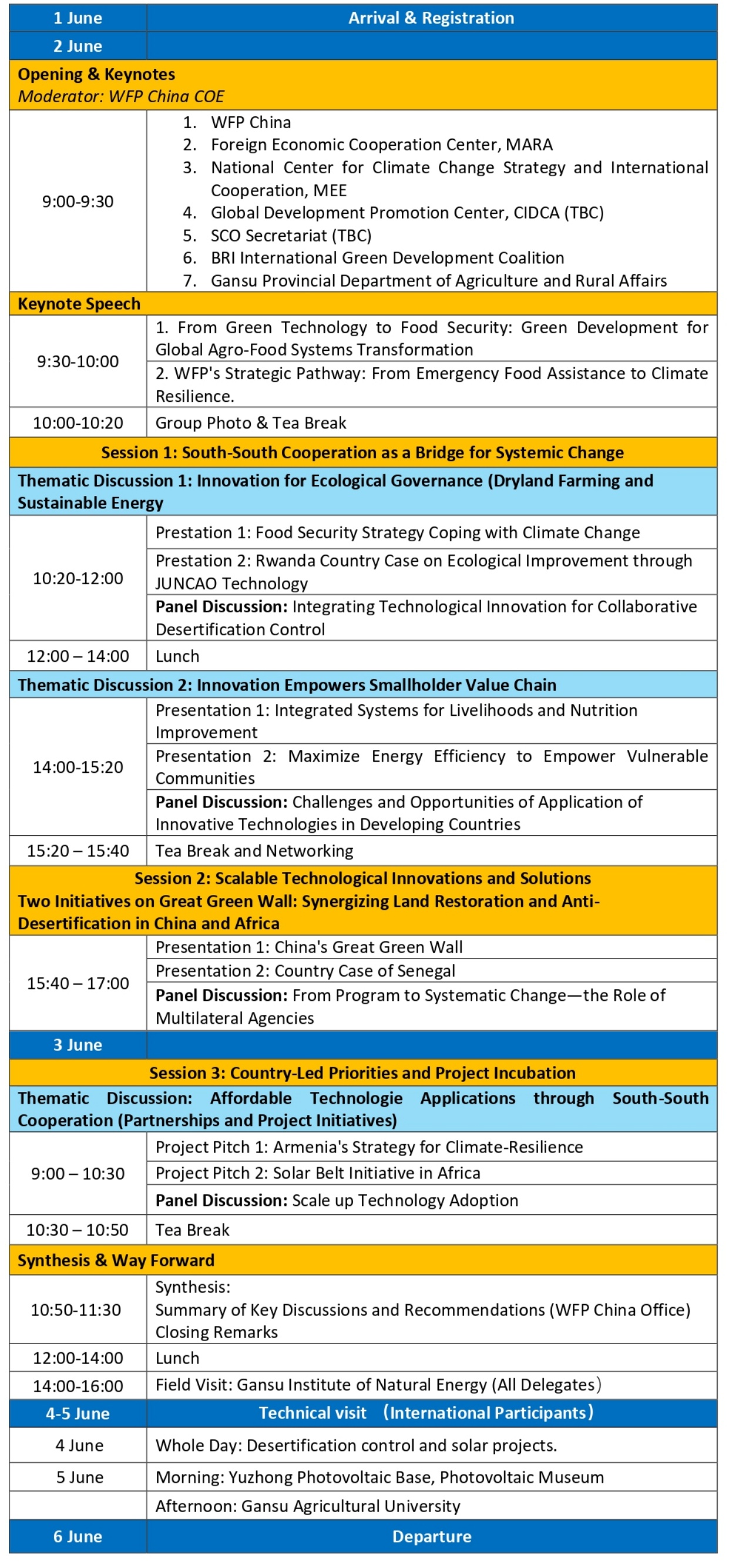
Annex: Provisional Agenda