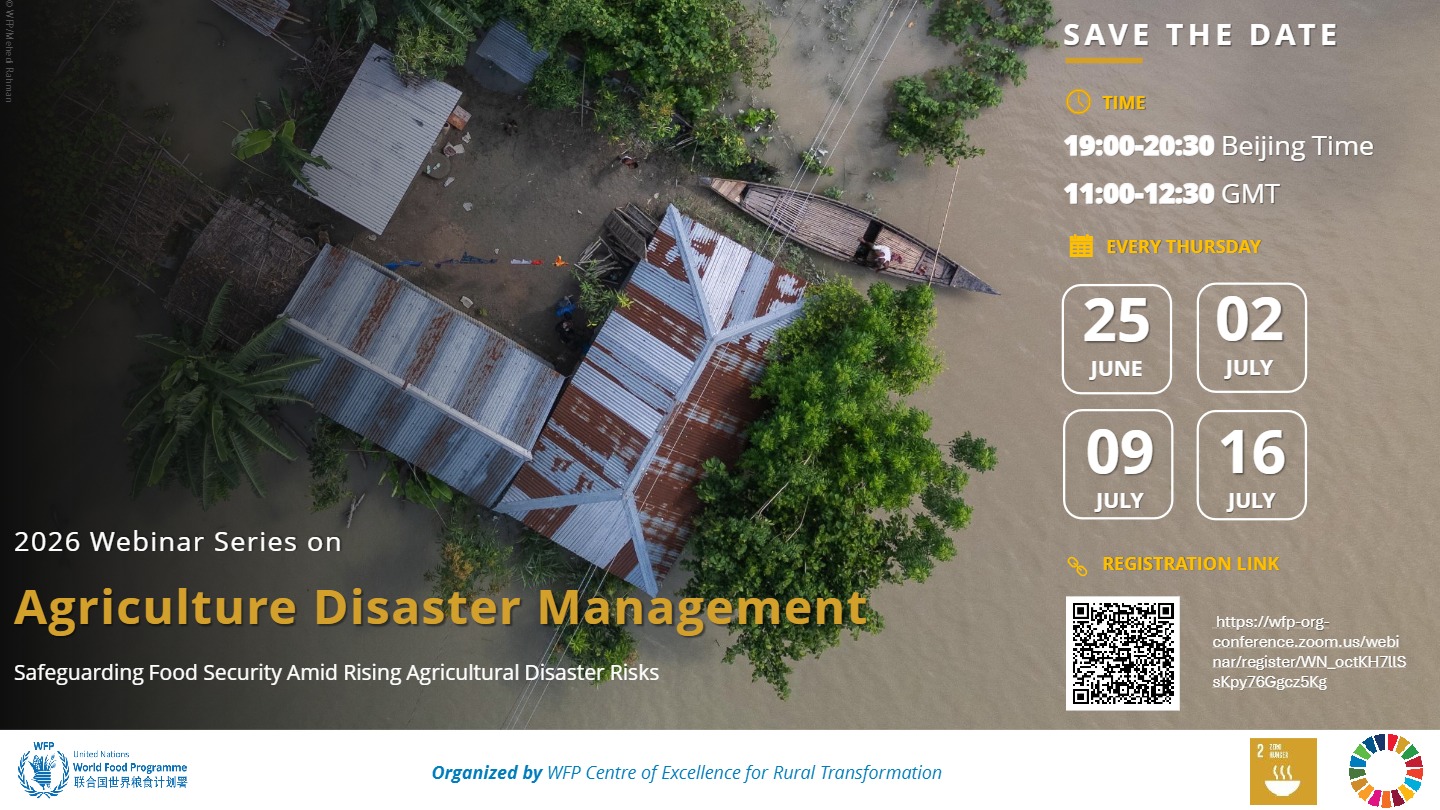
Please kindly find the REGISTRATION link: https://wfp-org-conference.zoom.us/webinar/register/WN_octKH7llSsKpy76Ggcz5Kg
Background
Agriculture is among the sectors most vulnerable to disasters due to its heavy dependence on natural resources and climate conditions. Agricultural disasters are increasing in frequency, intensity, and complexity, posing mounting risks to global food security. According to FAO’s latest report, disasters caused USD 3.26 trillion in losses to global agriculture between 1991 and 20231, with annual damages increasing from USD 64 billion in the 1990s to USD 144 billion in recent years. These shocks affect all agricultural subsectors and continue to erode the resilience of agrifood systems, driven by climate change, extreme weather events, and structural vulnerabilities in rural livelihoods.
Disasters increasingly undermine food security by disrupting agricultural production, damaging essential infrastructure, reducing household incomes, and weakening national capacities to maintain stable food supplies. In lowincome countries, the economic impact is particularly severe, with agricultural GDP losses reaching up to 15 percent following major disaster events2. WFP reports that climate extremes are a key driver of food insecurity, noting that more frequent and intense floods, droughts, and storms account for up to 90% of hazards worldwide3, eroding rural livelihoods and overwhelming response systems.
In this context, strengthening government coordination, anticipatory action, earlywarning and impactbased forecasting, agricultural insurance, lastmile digital alert tools, and practical technological solutions have become essential for protecting farmers and safeguarding food systems. China has accumulated extensive experience in agricultural disaster management, combining advanced meteorological systems, digital early warning tools, efficient response mechanisms, and practical technologies that support farmers at scale. These experiences are highly relevant for developing countries facing similar climate and disaster risks.
The webinar is fully aligned with the WFP Strategic Plan (2026–2029), which identifies riskinformed, climateresilient, and shockresponsive food systems as critical pathways to achieve food security. By showcasing these sound experiences and facilitating knowledge exchange with developing countries, this webinar series directly contributes to WFP’s global mandate to strengthen national capacities and enhance resilience against climateinduced agricultural disasters.
1FAO. 2025. The Impact of Disasters on Agriculture and Food Security 2025 – Digital solutions for reducing risks and impacts. Rome. https://doi.org/10.4060/cd7185en.
2FAO. 2023. The Impact of Disasters on Agriculture and Food Security 2023 – Avoiding and reducing losses through Investment in resilience. Rome. https://doi.org/10.4060/cc7900en.
3WFP Website: https://www.wfp.org/anticipatory-actions
Objective
The Webinar series aims to:
1) Strengthen knowledge sharing and exchange on effective agricultural disaster management.
2) Enhance institutional and technical capacities of the participants on sound practical tools, operational models, and proven technologies.
3) Promote South–South Cooperation and multistakeholder collaboration by facilitating dialogue among governments, academic institutions, private sectors and international development partners to identify scalable, contextappropriate solutions and foster joint efforts.
Organization and Participation
The webinar series will be organized by WFP Centre of Excellence for Rural Transformation (WFP China COE) with the technical support of China Meteorological Administration and the United Nations Economic and Social Commission for Asia and the Pacific (ESCAP).
The webinar series will be conducted via ZOOM. It is a public, online capacity-building initiative targeting government officials, technical experts, enterprises and other stakeholders who engaged in agricultural disaster management in developing countries. Staff from WFP and other international organizations working on relevant topics or with an interest in these subjects are also welcome to participate.
All sessions will offer simultaneous interpretation in Chinese, English, French, and Spanish to ensure inclusive participation. The webinar recordings will be edited and uploaded at the WFP-China South-South Cooperation Knowledge Platform and Cloud School (www.wfpchinacoe.net) as video courses.
A Certificate of Completion will be awarded to participants who attend every session in full. Participants are requested to register with their official full name and a valid email address for certificate issuance. WFP China COE reserves the final authority on all matters concerning certificate eligibility and issuance.
Programme
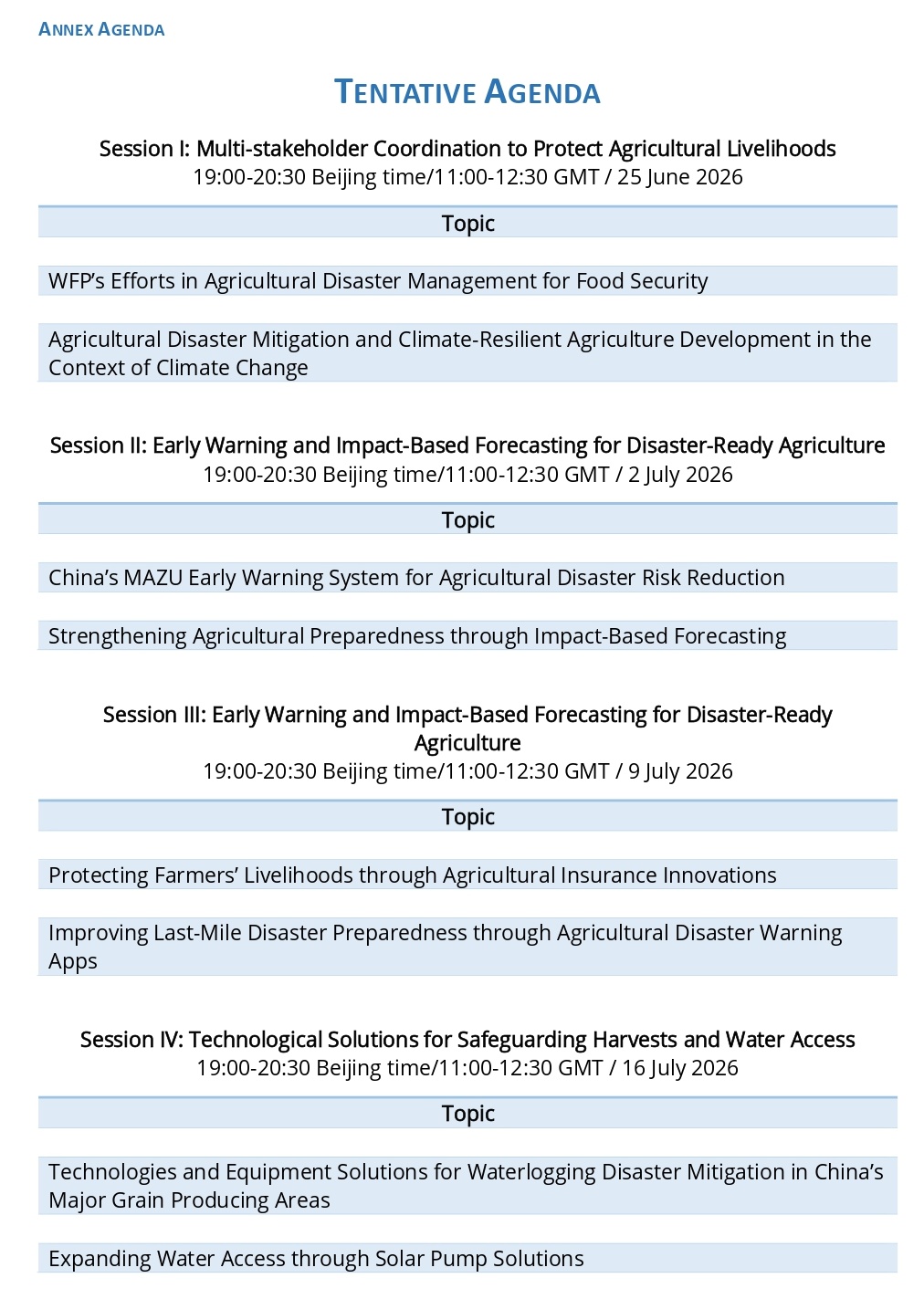
Four webinar sessions will be held from 19:00-20:30 Beijing Time (11:00-12:30 GMT) on Thursdays from 25 June to 16 July 2026. Each session will feature thematic presentation by guest speakers followed by interactive discussions with participants. A post-session survey will be administered to collect participant feedback and identify priority areas for future capacity building initiatives.
Please refer to the Annex for agenda details.
Additional Notes:
· All agenda times are in Beijing Time (GMT+8).
· Participants are advised to join 5–10 minutes early for smooth access.
· For inquiries, contact the focal point at sha.sha@wfp.org