The land in Nariou Village, Burkina Faso, which had previously remained underutilized, is now being cultivated for fruits and vegetables following the introduction of China–Africa agricultural cooperation initiatives. Before the cooperation began, local households relied heavily on rainfall, faced persistent food insecurity, and had limited opportunities to increase their income.
Under the Third Phase of China’s Agricultural Technical Assistance Project to Burkina Faso, Chinese agricultural experts worked on-site with local communities to improve water access, introduce improved crop varieties, and provide technical training. These efforts addressed long standing water constraints, supported the adoption of higher-yield hybrid rice, and promoted integrated crop–livestock production systems, contributing to more diversified and resilient rural livelihoods.
The transition of Nariou from a deeply impoverished village to a functioning demonstration site reflects the role of sustained technical cooperation and capacity development. It also illustrates the principles of mutual benefit and practical collaboration that underpin China–Africa cooperation within the broader framework of South–South cooperation.
1. Previous Challenges: Rain-fed Agriculture and Limited Income Opportunities for Women
Nariou Village, located in the central-western region of Burkina Faso, was previously characterized by high levels of rural poverty. For many years, agricultural production depended almost entirely on rainfall. During the long dry season, the absence of effective irrigation systems left most farmland unused for more than half the year, resulting in low and unstable crop yields and persistent food insecurity. Women, in particular, faced limited opportunities for employment and income generation.
After China and Burkina Faso resumed diplomatic relations in 2018, Nariou Village was designated as a comprehensive poverty-reduction demonstration site supported by China. Under the Third Phase of China’s Agricultural Technical Assistance Project to Burkina Faso, Chinese experts began working on-site with local communities. Their support focused on improving water infrastructure, strengthening agricultural production systems, providing technical training, and facilitating livelihood development. These interventions formed the basis for subsequent improvements in agricultural productivity and women’s economic participation.
2. Improving Water Access and Land Use: Addressing Water Constraints to Enhance Agricultural Production
Water availability has been a critical factor affecting poverty reduction in Nariou Village. To address the long-standing challenges of water scarcity and the widespread fallowing of farmland during the dry season, the Chinese agricultural expert team conducted field assessments and developed technical plans with local stakeholders. The project supported the construction of water storage ponds and solar powered wells, helping to improve access to water for both household use and agricultural irrigation.
With more reliable water supply, local farmers are no longer fully dependent on rainfall, and agricultural production has become more stable across seasons. During the rainy season, rice fields can receive timely supplementary irrigation, contributing to more consistent yields. Land that previously remained unused during the dry season is now cultivated with tomatoes, onions, celery, potatoes, and other marketable crops, enabling multiple cropping cycles. These changes created a foundation for diversified agricultural activities and increased opportunities for women to participate in production closer to home.
The expert team also provided guidance on the use of low-lying areas to expand rice cultivation, and the total rice-growing area in the village has reached 50 hectares.
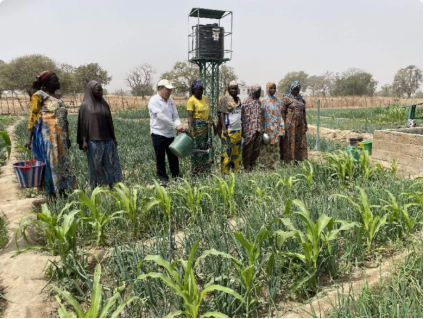
Sun Guofeng, the water-resources expert, explains dry-season water saving irrigation techniques using solar-powered wells to local women.
3. Improved Varieties and Cultivation Practices: Strengthening Rice Production and Income Stability
To enhance local food production, the Chinese agricultural expert team promoted improved rice-growing practices, providing hands-on training across the full production cycle—from land preparation and sowing to water and nutrient management and environmentally friendly pest control. Women were encouraged to participate in these trainings, enabling them to acquire practical skills and play a more active role in rice cultivation.
The team also introduced and evaluated three high-yield hybrid rice varieties from China that were suitable for local agro-ecological conditions, all of which were approved through Burkina Faso’s national variety registration process. By 2025, hybrid rice had been adopted across all rice fields in Nariou Village. With the use of improved varieties and cultivation techniques, average yields reached 9.2 tons per hectare—more than three times the national average. Total village rice production reached 460 tons, with an estimated market value of over 82 million CFA francs.
Higher and more stable yields have contributed to improved household food security and provided opportunities for farmers to generate cash income from surplus production. Rice production has also become an important entry point for employment for women’s participation in the agricultural value chain.
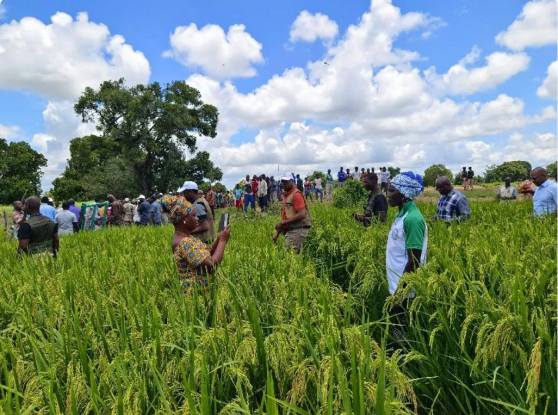
Local residents visit the fields in Nariou Village to observe the harvest of hybrid rice introduced from China.
4. Integrated Crop–Livestock Systems: Diversifying Local Livelihoods
To broaden livelihood opportunities and strengthen the resilience of local production systems, the Chinese agricultural expert team supported the development of an integrated model combining rice cultivation, aquaculture, and poultry production. This approach created both longer term and shorter-term income streams and expanded employment opportunities for women in the community.
Nariou Village had no prior experience with aquaculture, and local residents were unfamiliar with related techniques. Using project-supported ponds, the expert team helped upgrade 15 hectares of fishponds and provided 3,000 tilapia and catfish fingerlings at no cost. They also offered training on practical skills such as ecological polyculture, water quality management, and feeding practices, enabling community members to gradually acquire aquaculture competencies. In 2025, the first year of implementation, aquaculture activities produced 540 kilograms of marketable fish, generating approximately 1.08 million CFA francs in income.
A local resident, Adama Kaboré, noted that aquaculture had not previously been considered a livelihood option in the village and that the technical guidance provided through the project helped introduce a new source of household income.
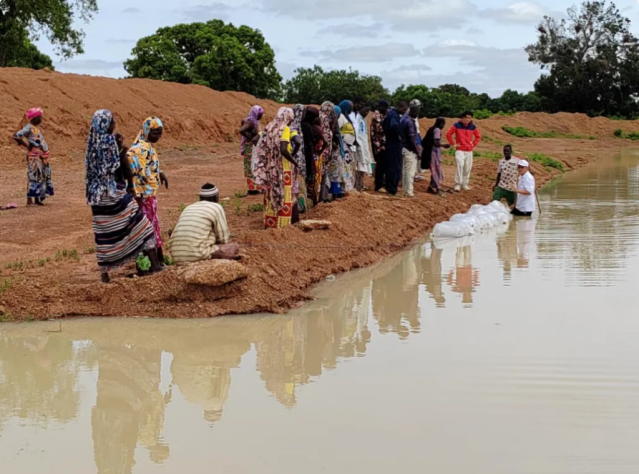
Aquaculture expert Deng Chengang provides training on pond disinfection and fish-fingerling stocking techniques.
Aïcha Ouédraogo, a resident of Nariou Village, noted that raising poultry now provides her with a steady monthly income, helping her cover household expenses such as school fees. Her experience reflects the outcomes of the poultry-support activities implemented under the project. To expand income opportunities for women, the Chinese agricultural technical team introduced a model that combines centralized training, household-level poultry raising, and continuous technical guidance, enabling women to acquire practical skills without leaving the village.
In September 2025, Aïcha received 20 improved-breed chicks through the project’s support scheme. She participated in five dedicated training sessions, learning feeding practices and basic animal health management from technical staff. With regular guidance, her flock maintained a survival rate of over 90 percent, and the broilers reached an average weight of 1.8 kilograms after three months. By the end of the year, she sold 14 broilers, earning 56,000 CFA francs, while the remaining six hens produced eggs that generated an additional daily income of 400–500 CFA francs.
Encouraged by her experience, more women in the village began participating in poultry activities, and cumulative income from poultry raising in Nariou has exceeded 1.75 million CFA francs. The integrated model has therefore supported both livelihood diversification and women’s economic engagement.
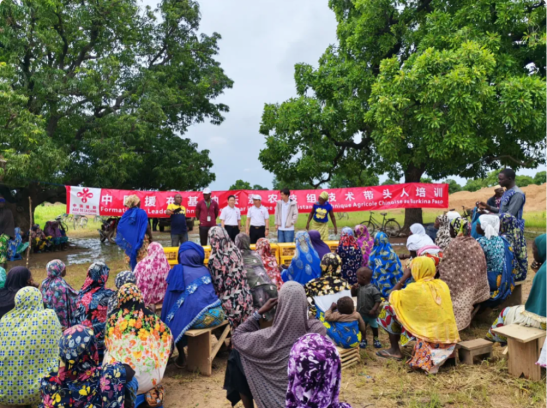
Women in Nariou Village participate in a training session for local technical leaders organized by the Chinese agricultural assistance team.
5. Women’s Participation: Strengthening Their Role in Local Agricultural Development
Kalidiata, a woman from Nariou Village, explained that she previously had no experience beyond household work but was able to learn aquaculture techniques through the training provided under the Chinese agricultural assistance project. She became the first woman in the village to apply these techniques in practice. The project team has conducted six agricultural training sessions in the village, with women making up the majority of participants.
Following the trainings, women have taken on active roles in rice cultivation, vegetable production, poultry raising, and other livelihood activities. A total of 167 women have transitioned from primarily household responsibilities to becoming key contributors in different agricultural sectors. In 2022, seven of the ten award recipients in a rice-yield improvement competition organized by the project team were women. Within the village agricultural cooperative, women hold three of the five management positions, reflecting their increasing involvement in local development processes.
As more women adopt improved agricultural practices and participate in income-generating activities, household livelihoods have become more stable. Their increased participation has also contributed to broader community-level development outcomes.
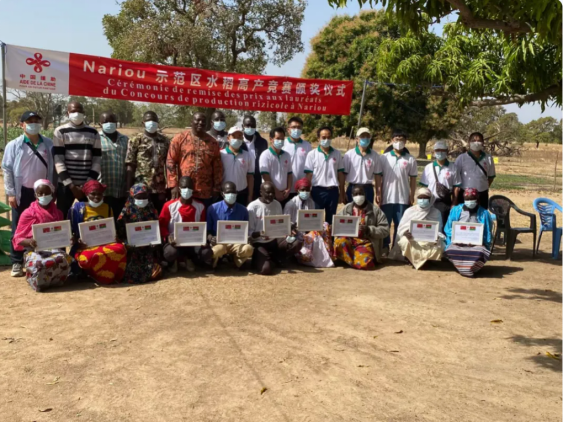
Seven women in Nariou’s demonstration area received awards in the “Top Ten Rice Growers” competition.
6. China–Africa Cooperation: Long-Term Technical Support and Community Engagement
The Chinese agricultural technical team has built working relationships with residents of Nariou Village through long-term field engagement and practical support, and many villagers refer to them informally as “family from China.” The team has contributed to improvements in water infrastructure, the introduction of improved crop varieties, and the dissemination of cultivation and livestock raising techniques. These efforts have supported the village’s transition from a high-poverty community to a demonstration site for integrated poverty-reduction initiatives and have expanded employment and income opportunities for women.
The collaboration reflects ongoing China–Africa cooperation in agricultural development and illustrates how technical assistance and capacity-building efforts can support more sustainable rural livelihoods.
Category
Women’s Income Generation under China–Burkina Faso Agricultural Cooperation
Contributor
Women’s Income Generation under China–Burkina Faso Agricultural Cooperation
Country
Technical Solution