This summary outlines the article From input-driven to efficiency-sustained growth: Four decades of transformation in China's national agricultural programs, authored by a research team led by Academician Fusuo Zhang at China Agricultural University. The article was published in Global Food Security (2026, Article 100930; ISSN 2211-9124) and is accessible via https://doi.org/10.1016/j.gfs.2026.100930 .
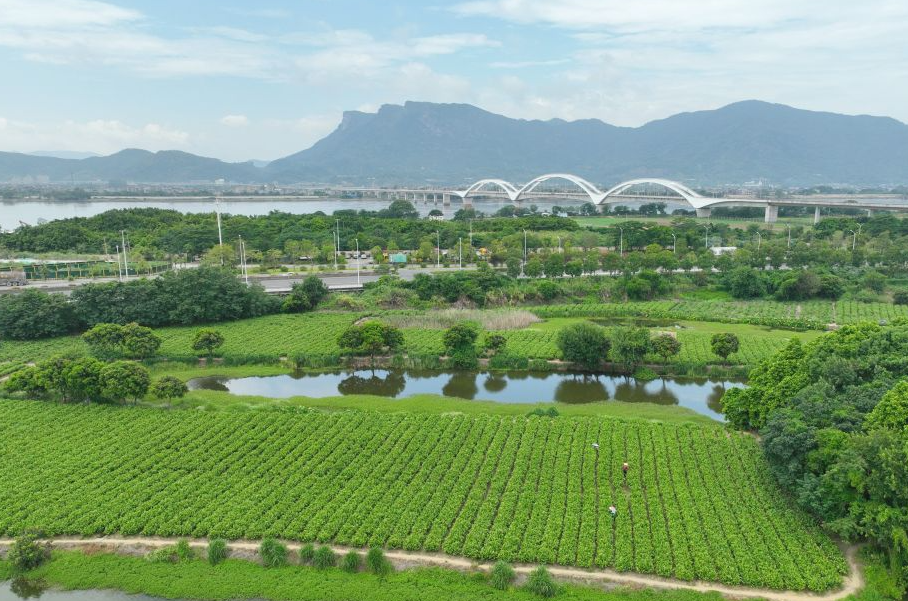
Over the past four decades of China’s agricultural development, the logic of agricultural growth has been shifting from “increasing production through higher inputs” toward “maintaining production through improved efficiency”. This study analyses major crops in China from 1980 to 2020. Drawing on multiple categories of factors—including agricultural infrastructure, fertilizer inputs, soil fertility, cropping systems, climate, and topography—the study uses an ensemble machine‑learning model to systematically evaluate the impacts of national agricultural programs on crop yield and fertilizer use efficiency (FUE). The research finds that over the past forty years, China’s average crop yield increased from 2.9 tons per hectare to 5.7 tons per hectare, nearly doubling. At the same time, spatial disparities in yield narrowed significantly, indicating that China’s agricultural development has not only increased total production but also improved regional production stability to some extent. According to the model results, approximately 80% of the spatiotemporal variation in crop yield and FUE can be explained by factors such as agricultural infrastructure, fertilizer inputs, soil fertility, climate, and regional conditions, and about 59% of the yield improvement is associated with changes driven by national agricultural programs.
The study divides China’s agricultural development over the past forty years into a clear transformation process. From 1980 to 2000, China was in a typical “input‑driven yield-growth phase.” During this period, China faced population growth, shrinking cropland, and pressure on grain supply, and the core objective of agricultural policy was to increase grain production. As a result, fertilizer use, irrigation facilities, and agricultural mechanization expanded rapidly, driving substantial increases in crop yield. The study shows that in the 1980s, China’s crop yield increased by 37% within a decade, equivalent to an increase of 1.2 tons per hectare. Meanwhile, fertilizer use rose sharply: between 1980 and 2010, fertilizer inputs per unit area increased from 0.12 tons per hectare to 0.59 tons per hectare. However, this growth came at a clear cost: fertilizer use efficiency declined from producing 30 tons of crop per ton of fertilizer to only 12 tons per ton of fertilizer. This indicates that during the yield‑increase process, an increasing share of fertilizer was not effectively converted into crop production but instead contributed to environmental pressures such as nitrogen and phosphorus losses, greenhouse gas emissions, soil acidification, and water eutrophication.
After 2000, China’s agriculture entered a phase that emphasized both high yield and high efficiency. Policy priorities during this period shifted from focusing solely on yield increases to gradually emphasizing resource‑use efficiency and environmental impact control. The article notes that “high yield and high efficiency” programs promoted more rational nutrient management and the wider adoption of improved agricultural technologies. For example, between 2005 and 2015, related programs mobilized large numbers of farmers to adopt improved management practices, reducing nutrient losses across extensive farmland without lowering yields. The study also shows that after 2000, the importance of fertilizer inputs in explaining yield variation gradually declined, while the importance of irrigation capacity, soil fertility, and agricultural infrastructure increased. This indicates that the drivers of yield growth in China began to shift from relying primarily on fertilizer inputs toward a more integrated set of drivers involving water‑nutrient management, infrastructure improvement, and soil‑quality enhancement.
After 2010—especially following the launch of the “Zero Growth of Chemical Fertilizer and Pesticides” initiative in 2015—China’s agriculture entered a more pronounced “efficiency‑sustained growth phase.” The study shows that after 2010, national fertilizer inputs began to decline, and over the five years following 2015, fertilizer use decreased from about 60 million tons to 53 million tons, a reduction of roughly 13%. Meanwhile, fertilizer use efficiency increased by 18%, and overall crop yields remained stable. This shift is highly significant because it demonstrates that China’s agriculture has started to break away from the traditional assumption that “reducing fertilizer inevitably leads to yield loss.” In most regions, improvements in agricultural infrastructure and soil fertility offset the negative effects of fertilizer reduction on yield, enabling the agricultural system to maintain production capacity while reducing inputs. In other words, China’s agriculture is transitioning from “using more fertilizer to produce more grain” to “safeguard food security through higher efficiency.”
However, the study also cautions that this transition has not proceeded equally smoothly across all regions. In the 2010s, most prefecture‑level regions saw stable or increasing crop yields and significant improvements in fertilizer use efficiency. But in parts of Northeast and Northwest China, national programs improved fertilizer use efficiency while crop yields declined. This indicates that in some emerging grain‑producing areas or regions with stronger resource constraints, simply reducing fertilizer inputs may pose yield risks. If irrigation conditions, soil fertility, and agricultural infrastructure are insufficient to support production after fertilizer reduction, overly rapid or excessive fertilizer cuts may affect food security. Therefore, future agricultural green transformation should not be understood as “continuing to reduce fertilizer,” but rather as emphasizing more precise nutrient management based on soil nutrient supply, crop demand, and regional production conditions.
In terms of driving factors, the article further reveals deeper shifts in the drivers of China’s agricultural growth. From 1980 to 2000, fertilizer inputs were the most important factor influencing crop yield and fertilizer use efficiency. But by 2020, the importance of fertilizer inputs in explaining yield had declined significantly, while the roles of irrigation capacity, topographic conditions, climate factors, and soil quality became more prominent. This indicates that once agricultural production reaches a relatively high level, the marginal benefits of increasing fertilizer inputs diminish, and further yield improvements increasingly depend on water‑resource security, soil health, cropping‑system optimization, and region‑specific management. Especially under climate change, precipitation variability, droughts, heatwaves, and other extreme events will have more pronounced impacts on crop yields, requiring agricultural policy to shift from single‑factor input management towardmore integrated “water–fertilizer–soil–climate” governance.
This study offers strong insights for future agricultural policy in China. First, China still faces food‑security pressures: urbanization reduces cropland, dietary shifts increase demand for soybeans and feed grains, food waste remains substantial, and demographic changes affect the stability of the food system. Therefore, stabilizing and improving yield per unit area remains a core priority. Second, fertilizer use efficiency still has considerable room for improvement, especially given significant regional disparities. China cannot adopt a uniform national fertilizer‑reduction target; instead, differentiated strategies should be developed based on regional soil fertility, historical nutrient accumulation, crop types, and yield levels. Third, manure recycling, straw incorporation, soil‑testing‑based fertilization, high‑standard farmland construction, and agricultural extension models such as “Science and Technology Courtyards” may become important tools for simultaneously achieving yield improvement, efficiency gains, and emission reductions. The article notes that under stable input levels, China’s crop yields still have a potential increase of about 0.35 tons per hectare over the next decade, and fertilizer use efficiency can continue to improve. Whether this potential can be realized ultimately depends on long‑term soil nutrient dynamics and the rationality of management practices.
Overall, the success of China’s agriculture over the past forty years lies not only in “doubling crop yields,” but more importantly in the transformation of its growth model. In the early years, yield increases relied on rapid expansion of fertilizer use, irrigation, and mechanization, but this also led to declining fertilizer efficiency and rising environmental pressures. Subsequently, through policies such as high‑yield and high‑efficiency programs, the zero‑growth fertilizer initiative, and agricultural green development, China gradually achieved stable yields alongside improved resource‑use efficiency. The key for the next stage of China’s agricultural development is not simply increasing inputs, nor mechanically reducing them, but ensuring food security through precise fertilization, soil‑health improvement, enhanced agricultural infrastructure, and region‑specific management—ultimately achieving a sustained transition from “input‑driven growth” to “efficiency‑supported growth.” In other words, the core task for China’s agriculture moving forward is not to produce more grain with more resources, but to produce sufficient and sustainable grain with lower environmental impacts.
Click here to access the full article for more detailed information.