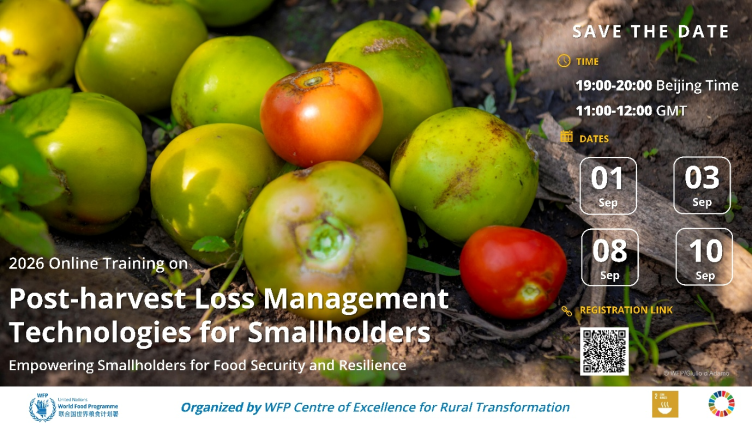
Please kindly find the REGISTRATION link: https://us06web.zoom.us/webinar/register/WN_w3c9cht4Q8mV4RE8W8ypvA
Background
Food security remains a top priority forthe global community, yet it continues to pose a significant challenge. In 2025, an estimated 2.1 billion people – 25.8 percent of the global population – were moderately or severely food insecure, and new global estimates of hunger confirm sustained, gradual improvement.
Post-harvest losses is a critical yet often overlooked driver of food insecurity worldwide. Approximately 13.3 percent of food produced globally is lost after harvest—during handling, storage, transport, and processing—before it even reaches retail markets. The post-harvest losses in Sub-Saharan Africa are estimated at more than 30% of the total harvestand loses up to 50% of fruits and vegetables produced annually, and in South Asia, over 30% of all food in the region is lost or wasted each year, which is enough to feed nearly 300 million people.
Smallholder farmers constitute the backbone of global food security, when they are the major food producer in developing countries contributing roughly 35 percent of global food production. However, losses are particularly acute among smallholder farmers because they often lack access to improved technologies, adequate infrastructure, and modern handling and storage practices. These constraints make it difficult to maintain product quality after harvest, leading to higher levels of spoilage, pest infestation, and moisture-related damage compared with larger commercial producers.
Reducing post-harvest losses among smallholders is one of the most cost-effective and sustainable pathways to improving food availability. Even modest improvements can generate substantial gains: by preserving more of what is already produced, countries can enhance food security without expanding agricultural land, reduce pressure on natural resources, increase farmers’ incomes, improve rural livelihoods, and strengthen national food systems in the face of climate and market shocks. Importantly, smallholders themselves stand to benefit the most. Lower losses mean higher marketable volumes, more stable earnings, reduced vulnerability to seasonal price fluctuations, and greater capacity to reinvest in improved technologies and practices—ultimately strengthening their resilience and long-term productivity.
Since 2016, WFP Centre of Excellence for Rural Transformation (WFP China COE)has convened a range of thematic South-South and Triangular Cooperation (SSTC) capacity building activities to help developing countries enhance food security and strengthen food system resilienceby sharing post-harvest loss management solutions and experience from China and other countries. Thousands of participants have benefited from the replicable experience through these initiatives.
Against this backdrop, the online training Empowering Smallholders for Food Security and Resilience – Online Training on Post-harvest Loss Management Technologies for Smallholders aims to introduce practical, scalable post-harvest management technologies and facilitate knowledge exchange among developing countries. By equipping smallholders and practitioners with proven tools and approaches, the training contributes to WFP’s global commitment in strengthening developing countries’ food security and food system resilience, while advancing South-South and Triangular cooperation for sustainable development.
Objective
The online training aims to
1) Strengthen knowledge sharing and exchange oneffective post-harvest management technologies for smallholders.
2) Enhance the institutional and technical capacitiesof the participants on sound practical tools, operational models, and proven technologies.
3) Facilitate cross-sector dialogue and partnership among diverse stakeholders to enrich the collective understanding of post-harvest challengesand explore practical and scalable solutions for smallholders.
Organization and Participation
The online training compassing four training sessions will be organized by WFP Centre of Excellence for Rural Transformation (WFP China COE) withthe technical support of China Agricultural University (CAU).
The online training will be conducted via ZOOM. It is a public, online capacity-building initiative targeting government officials, technical experts, enterprises and other stakeholders who engaged in post-harvest loss management for smallholders in developing countries. Staff from WFP and other international organizations working on relevant topics or with an interest in these subjects are also welcome to participate.
All sessions will offer simultaneous interpretation in Chinese, English, French, and Spanish to ensure inclusive participation.The webinar recordings will be edited and uploaded at the WFP China South-South Cooperation Knowledge Platform and Cloud School (www.wfpchinacoe.net) as video courses.
Certification
A Certificate of Completion will be awarded to participants who attendall four sessions, with no less than 50 minutes participation for each session. Participants are requested to register with their official full name and a valid email address to facilitate certificate issuance.
If participants cannot meet the required participation duration for thelive training sessions due to unforeseen technical or network difficulties, an alternative pathway is available. Participants may still obtain a certificate by completing the corresponding video courses on the WFP China South-South Cooperation Cloud School (http://cloudschool.wfpchinacoe.net/), which are derived from the original session recordings and materials.
WFP China COE reserves the final authority on all matters concerning certificate eligibility and issuance.
Programme
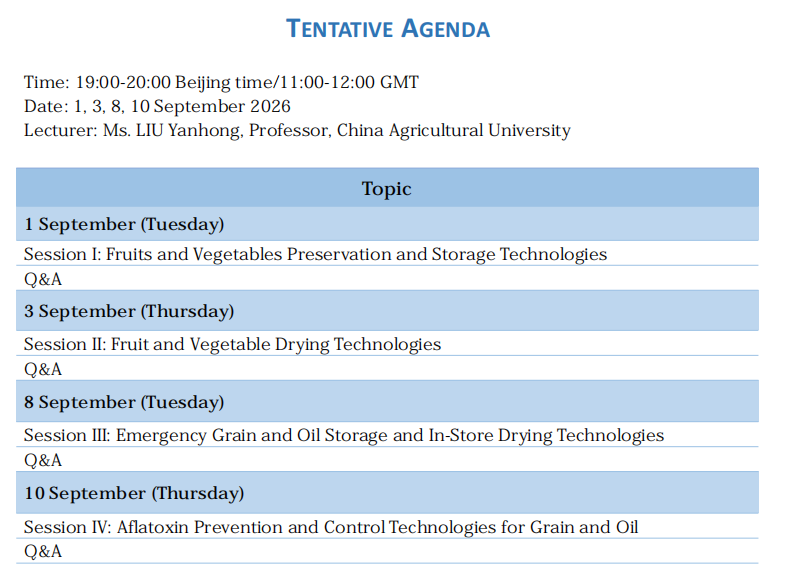
Four training sessions will be held from 19:00-20:00 Beijing Time (11:00-12:00 GMT) on Tuesdays and Thursdays from 1 to 10 September 2026. Each session will feature a thematic presentation followed by interactive discussions with participants.
A post-survey will be administered to collect participant feedback and identify priority areas for future capacity building initiatives.
Please refer to the Annex for agenda details.
Annex Agenda
Additional Notes:
· All agenda times are in Beijing Time (GMT+8).
· Participants are advised to join 5–10 minutes early for smooth access.
· For inquiries, contact the focal point at sha.sha@wfp.org