 Land degradation threatens rural livelihoods across the developing world. Large-scale ecosystem restoration programs offer a way out, yet they remain poorly understood in terms of their socioeconomic effects and transferable lessons. China’s Grain for Green (GforG) program, which was also called “the Returning Farmland to Forests Program” in the official documents, launched in 1999, offers an extensive evidence base on government-led smallholder land retirement at scale in low-and-middle income countries. By 2020, the program had converted approximately 14 million hectares of sloping cropland to forest or grassland across 25 provinces, compensating 41 million rural households at a cumulative central government investment exceeding USD 77.62 billion. Total program area, including restoration of non-cropland areas, reached approximately 34.33 million hectares.
This paper synthesizes evidence on the GforG’s design, implementation, and outcomes to distill transferable lessons for smallholder land restoration programs, particularly in low- and middle-income countries.
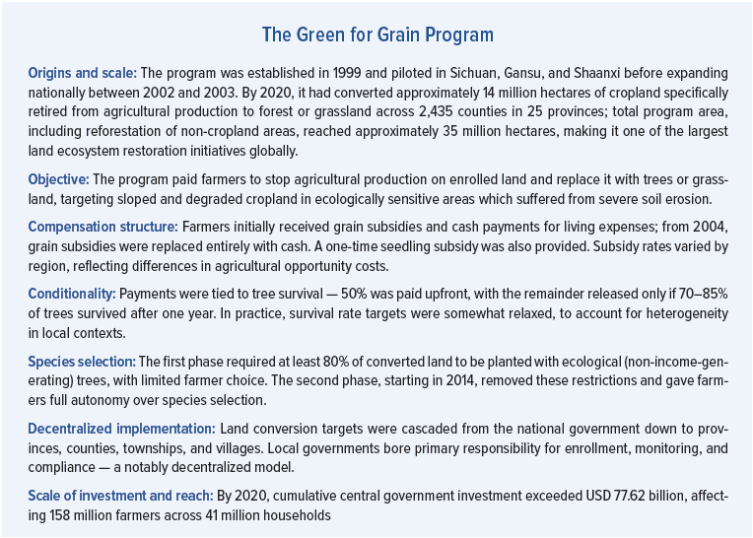
Design and implementation. The GforG operated through a four-level governance structure linking central policy commitments to provincial, county, and household implementation. Compensation evolved across three phases, from in-kind grain payments to differentiated cash subsidies. Targeting criteria, species requirements, and farmer autonomy were progressively refined as the program drew lessons from various implementation phases. The program began at considerable scale with a flexible design rather than beginning as a refined pilot; this flexible design enabled rapid learning across diverse contexts while tolerating known implementation imperfections in the early phases.
Economic outcomes. Compensation payments were modest relative to foregone agricultural income for many participants, and direct income effects from tree-planting were limited. Instead, the program’s most significant economic contribution was associated with indirect and possibly more sustainable channels: by retiring marginal land and relaxing liquidity constraints, it accelerated the reallocation of household labor to off-farm employment. Based on a consecutive field survey over twelve years, farming’s share in household income in the Beijing–Tianjin Sandstorm Source Control Project area under the GforG implementation declined by 44 percent while the share of off-farm income rose correspondingly, with the largest gains accruing to the lowest-income households. Distributional effects were broadly positive, with Gini coefficients declining substantially in participating provinces. Complementary investments in rural development, especially skills training, biogas infrastructure, and farmland consolidation, were critical to sustaining this transition.
Key lessons for policymakers. Five principles emerge from the GforG experience as most relevant for converting smallholder agricultural land into forestland or shrubland in low-and-middle income country contexts:
1. Clarify program intent upfront. Whether payments serve as a transitional bridge to alternative livelihoods or as compensation for lost incomes has different fiscal and policy implications. The GforG’s most successful outcomes occurred where payments facilitated labor transitions and where land was targeted using simple, low-cost proxies for determining opportunity costs and environmental benefits, such as slope.
2. Match fiscal commitment to transition timelines. Households may require longer than anticipated to establish viable alternative livelihoods; payment reductions should be gradual and contingent on evidence of successful economic transitions, supported by parallel investments in land tenure security, off-farm employment, and rural enterprise development to sustain outcomes once payments end.
3. Invest in human capital alongside land retirement. Skills training and support for off-farm labor transitions were vital for increasing incomes and reducing reconversion risk; direct payments alone were insufficient for improving economic outcomes if alternative livelihood pathways were absent.
4. Build in adaptive management from the start. Real-time monitoring and learning, transparent data sharing with research institutions, and flexibility in revising targeting criteria, payment structures, and tree species requirements are more important than optimizing initial design.
5. Align governance accountability with fiscal incentives. Clear assignment of responsibilities across government levels, performance-based payment mechanisms tied to verified outcomes rather than inputs, and community-level coordination structures are important for improving compliance in implementation of programs and equity in outcomes.
The GforG demonstrates that the ability of large-scale tree-planting on degraded farmlands can deliver both ecological benefits and improved economic outcomes for smallholders. Realizing this dual benefit, however, requires long-term thinking and depends on a confluence of conditions including institutional capacity, sustained fiscal commitment for payments and human capacity building, dynamic labor markets, and complementary rural development investments. Honest assessment of these enabling conditions is essential before adapting this model to other contexts.
Click here to access and download the full document for more detailed information.