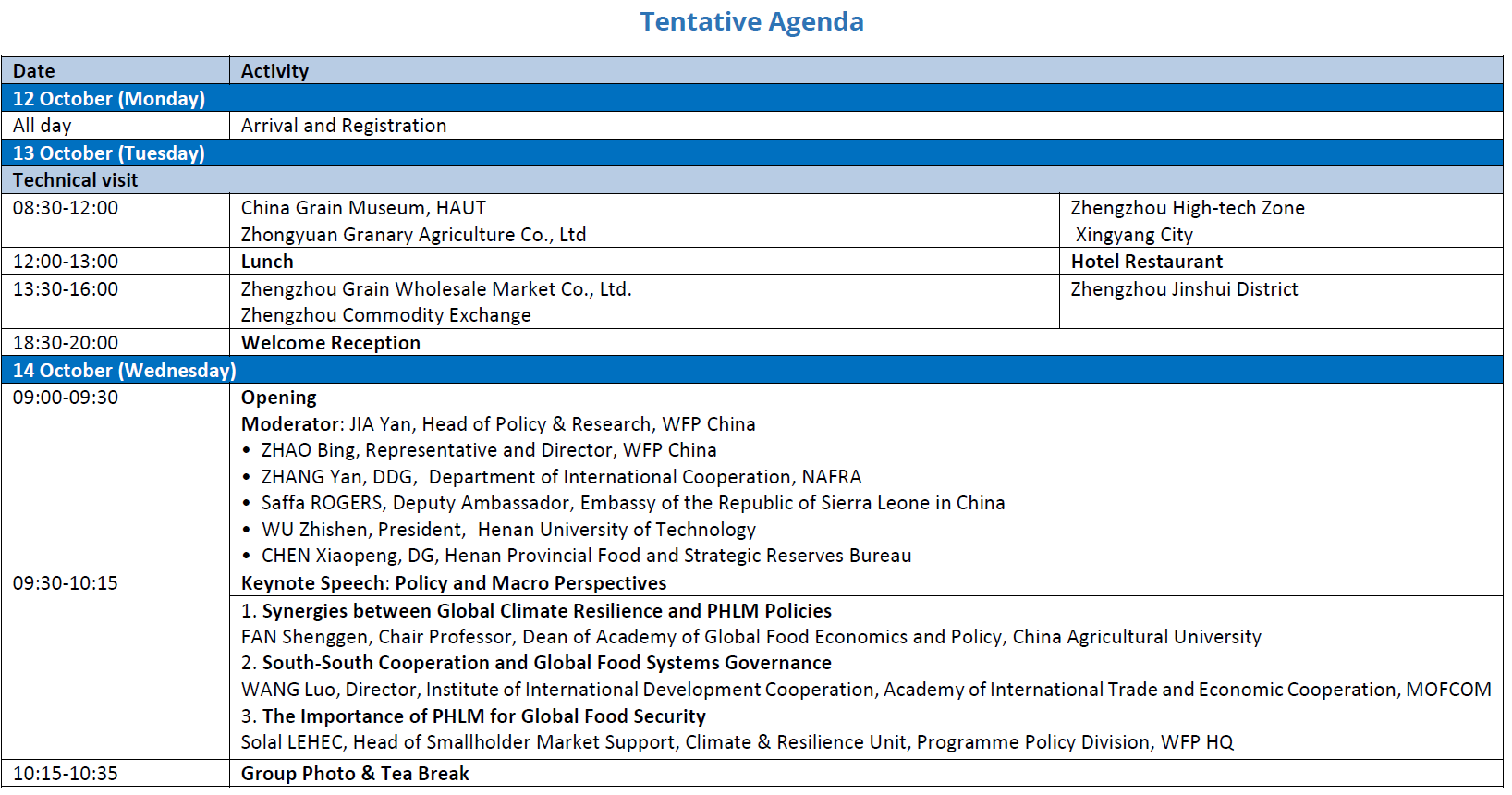
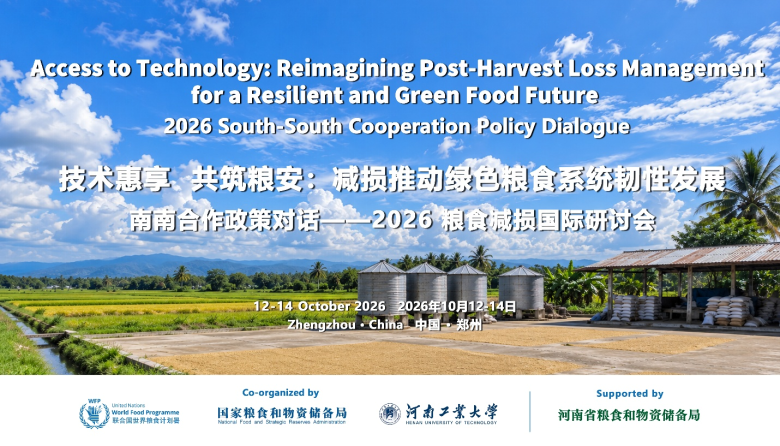
Date: 12-14 October 2026
Venue: Zhengzhou, China
Main Venue & Parallel Forum 1
Zoom ID: 938 6711 2404 | Passcode: 256494
Parallel Forum 2
Zoom ID: 934 9108 6254 | Passcode: 964513
Background
Global food security remains under severe pressure. Climate shocks, geopolitical conflicts and market volatility are compounding threats to the stability of food systems, with smallholder farmers and vulnerable populations in developing countries particularly exposed. The State of Food Security and Nutrition in the World 2026 (SOFI 2026) projects that approximately 510–520 million people will still face hunger by 2030. WFP's Strategic Plan (2026–2029) calls for stronger linkages between emergency response and resilience-building to strengthen the self-reliance of smallholder farmers and local value-chain actors. Achieving this requires technologies to be effectively adopted and put into practice.
According to FAO, 13.3 percent of food is lost between harvest and retail, resulting in economic losses of up to US$1 trillion each year. SOFI 2026 estimates that post-harvest activities account for 70–75 percent of consumer food expenditure and that, in 2025, an estimated 2.69 billion people, or 32.7 percent of the global population, were unable to afford a healthy diet. In developing countries, inadequate storage facilities, weak infrastructure, and gaps in policy and governance increase post-harvest losses and constrain smallholders' market access and income growth. Effective Post-Harvest Loss Management (PHLM) is therefore essential to strengthening food security, lowering food costs and increasing smallholder incomes.
WFP treats PHLM as a priority area and integrates it into smallholder support, market linkages and food supply chain management. Through Smallholder Agricultural Market Support (SAMS), local and regional procurement and related initiatives, WFP helps smallholders improve post-harvest handling, reduce losses and connect to stable markets. Since 2021, the WFP Centre of Excellence for Rural Transformation (WFP China COE), the Department of International Cooperation of the National Food and Strategic Reserves Administration (NAFRA) and Henan University of Technology (HAUT) have jointly organized South-South policy dialogues on PHLM. Following virtual editions in 2021 and 2022, the seminars held in Kaifeng in 2023, Changsha in 2024 and Wuhan in 2025 brought together participants from 44 countries.
Rational
PHLM directly supports two of WFP's three strategic outcomes: strengthening resilience to reduce future humanitarian needs and supporting governments to establish and strengthen national food security and nutrition systems. It also aligns with China's continued efforts to advance global cooperation on food loss and waste reduction. The Jinan Initiative, adopted in 2021, consolidated international consensus, while the Action Plan for South-South Cooperation on Food Loss and Waste Reduction, issued in 2025, identified policy research, digital technology, project cooperation, experience sharing and international cooperation as five priority areas.
Effective PHLM requires appropriate technologies and equipment alongside financing and risk sharing mechanisms, standards and quality management, training and maintenance services, infrastructure, market access and stable procurement relationships. Bringing these elements together is essential for sustained technology adoption and for ensuring that smallholders benefit from more efficient food value chains.
WFP China COE connects Chinese experience in storage, processing, digitalization, green technologies and post-harvest services with the needs of the Global South, promoting integrated solutions and the conditions required for technologies to be used sustainably.
Building on this shared understanding, WFP China COE, the Department of International Cooperation of NAFRA and HAUT will jointly convene the 2026 Seminar on Post-Harvest Loss Management in Zhengzhou, China, from 12 to 14 October 2026. Framed by resilient food systems and green development, the Seminar will strengthen linkages among policy, technology, infrastructure, finance and markets; identify country needs; share adaptable practices; match appropriate solutions with partners; and generate concrete opportunities for policy exchange and technical cooperation. It has been officially included in the Deliverables under the "Shared Future Action Plan" issued by the China International Development Cooperation Agency (CIDCA), underscoring its strategic value in advancing global agricultural development for shared benefit.
Objectives
The 2026 Seminar on PHLM will focus on the following objectives:
1. Advance policy dialogue and strategic alignment. Support advancement of WFP Strategic Outcomes 2 and 3 and strengthen the integration of South-South Cooperation with WFP operations.
2. Explore appropriate solutions and practical pathways for tangible action. Propose policy recommendations and action plan to advance concrete cooperation between WFP China COE and strategic partners.
3. Bridge the "last mile" of technology application. Explore practical pathways for translating appropriate technologies into tangible benefits for smallholders in developing countries, reducing recurrent humanitarian needs and strengthening self-reliance.
4. Build multi-stakeholder partnerships. Facilitate cooperation and matchmaking among participating countries, WFP country offices, Chinese solutions providers, financial institutes, academic institutions and private sectors to connect needs with solutions.
Event arrangement
• Hybrid format with onsite seminar in Zhengzhou and Zoom meeting virtually.
• The event will be in English, Chinese, and French. Simultaneous Interpretation will be provided.
Organization
The Seminar will be jointly organized by WFP China COE, the Department of International Cooperation of NAFRA and HAUT, with support from the Henan Provincial Food and Strategic Reserves Bureau.
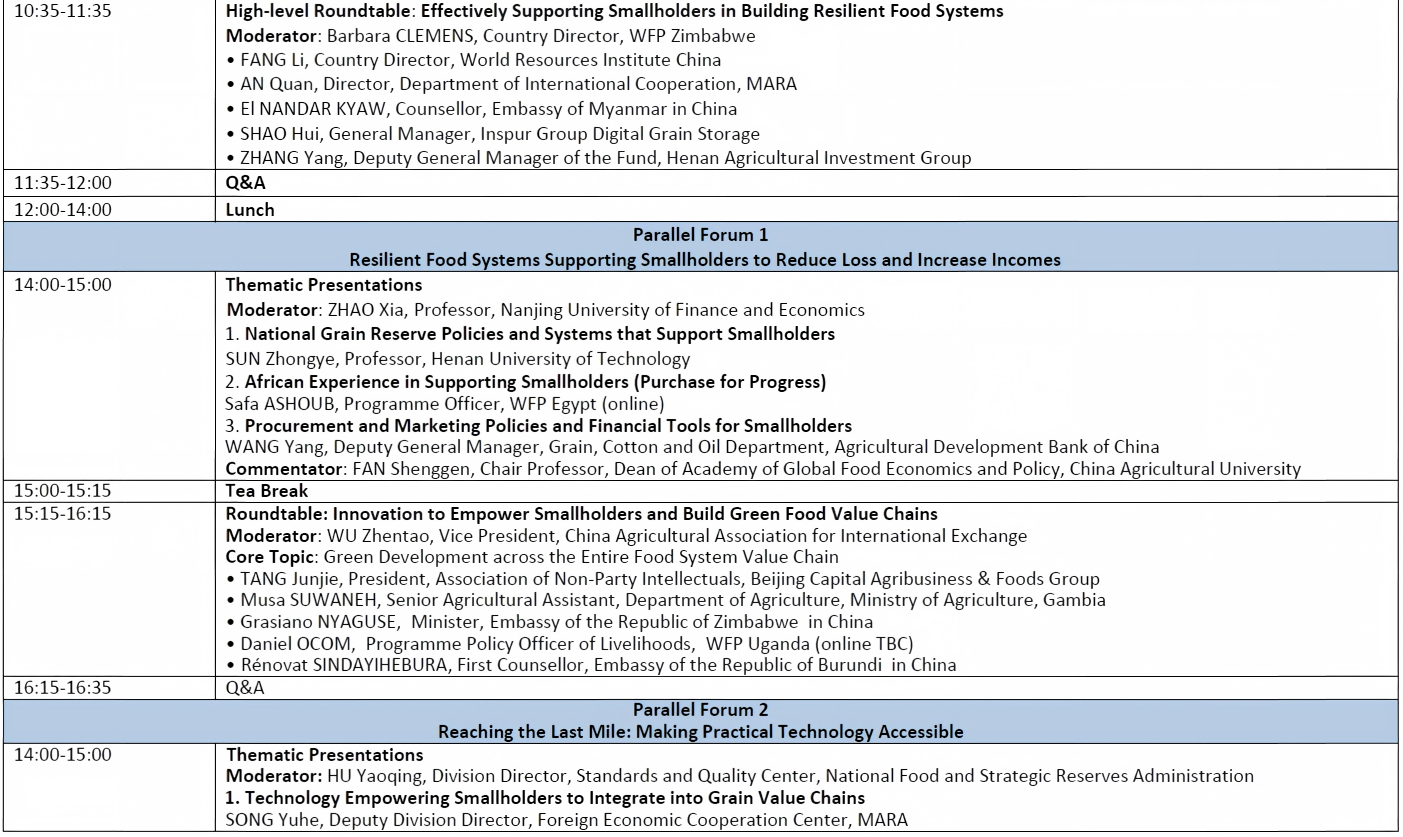
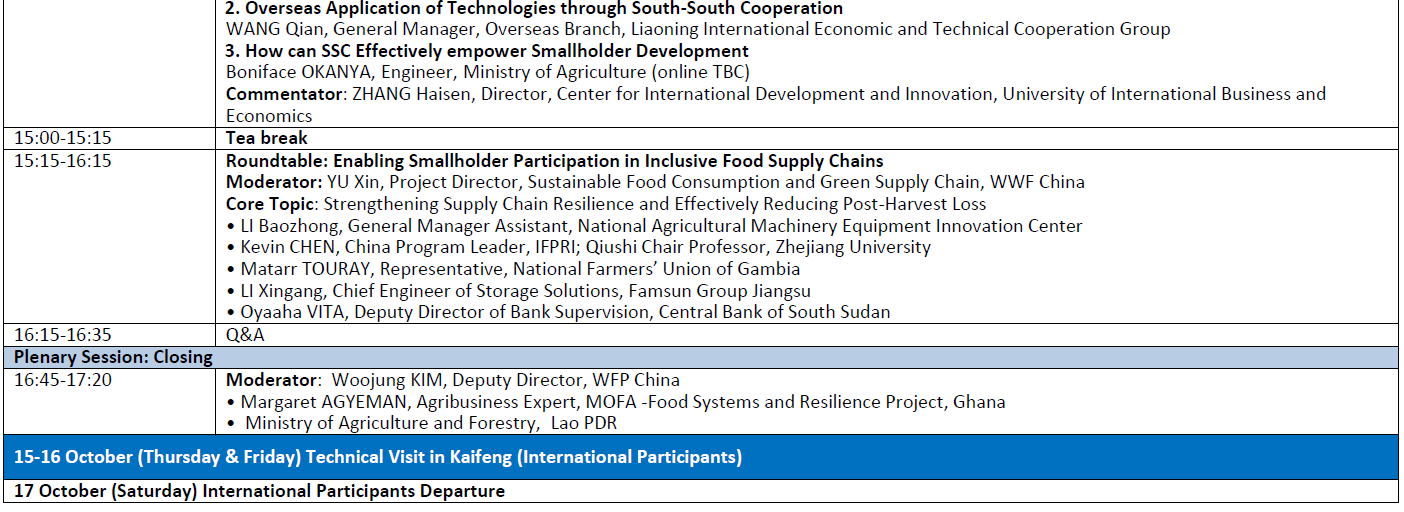
Annex: Tentative Agenda