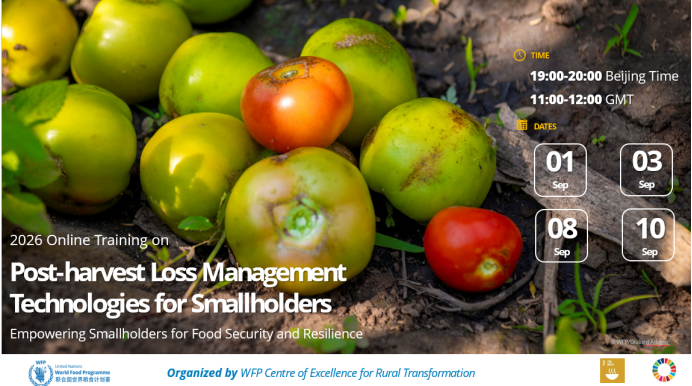
The WFP Centre of Excellence for Rural Transformation (WFP China COE) organized an online training on Post-harvest Loss Management Technologies for Smallholders from September 1 to 10, 2026. Presented by Professor Liu Yanhong from China Agricultural University, the four-session program provided a platform for knowledge exchange and experience sharing among developing countries. It aimed to equip participants with practical tools, operational models, and proven technologies for effective post-harvest management, thereby contributing to improved food security and agricultural resilience. The four sessions are as follows:
| Session I: Fruits and Vegetables Preservation and Storage Technologies |
| Session II: Fruit and Vegetable Drying Technologies |
| Session III: Emergency Drying of Grains and Oils |
| Session IV: Aflatoxin Prevention and Control Technologies: Solutions for Smallholders |
In response to widespread post-harvest losses worldwide, which threaten food security and the livelihoods of smallholder farmers, this webinar series introduces practical, field-ready post-harvest loss management technologies tailored to small-scale farming. Across four sessions, Professor Liu Yanhong from China Agricultural University presents a comprehensive range of post-harvest solutions covering fruit and vegetable preservation and storage, fruit and vegetable drying, emergency drying of grains and oils, and aflatoxin prevention and control. The series introduces low-cost, smallholder-friendly technologies, ranging from traditional natural-cooling storage, solar drying sheds, and rotary dryers to mobile and stationary grain dryers and in-bin drying systems. It also covers hermetic grain storage solutions, portable rapid detection devices, and biological detoxification approaches for aflatoxin contamination. In addition, the sessions explain key factors affecting produce storage, drying principles and technologies, two-stage strategies for emergency grain drying, and a four-step framework for aflatoxin preventionand control, supported by practical, field-tested cases. These practical and accessible technologies and operational approaches provide valuable references for developing countries seeking to reduce agricultural post-harvest losses, mitigate mycotoxin risks, enhance food safety, and strengthen the resilience of small-holder farming systems.
You can access the four webinar sessions in English, via the links provided in the table below.
| Session | Speaker | Link to the Cloud School |
|---|---|---|
Fruits and Vegetables Preservation and Storage Technologies | Prof. Liu Yanhong (China Agricultural University) | English: |
Fruit and Vegetable Drying Technologies | English: | |
Emergency Drying of Grains and Oils | English: | |
Aflatoxin Prevention and Control Technologies: Solutions for Smallholders | English: |