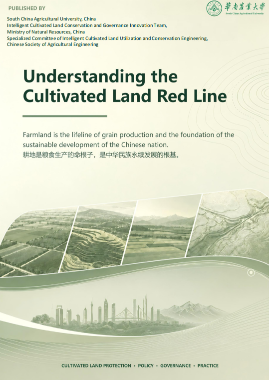
 Understanding the Cultivated Land Red Line is an illustrated publication that introduces China's approach to cultivated land protection and explains its importance for food security and sustainable development.
The publication explains China's cultivated land red line, a national policy safeguard designed to maintain the agricultural land base necessary for food production. The widely recognized "1.8 billion mu red line" corresponds to approximately 120 million hectares of cultivated land. However, cultivated land protection goes beyond maintaining a minimum area. It requires an integrated approach that considers land quantity, quality, ecological conditions, spatial planning, monitoring and accountability.
Cultivated land is presented as a living production system in which soil, water, nutrients, infrastructure and human management interact. Its value extends beyond food production to ecological functions, rural livelihoods and cultural landscapes. Protecting productive farmland is particularly important in the face of urbanization, climate risks, resource constraints and uncertainties in global food supply chains.
The publication also traces the evolution of China's farmland protection policy from a primary focus on maintaining the total area of cultivated land toward a more comprehensive framework integrating quantity, quality and ecological sustainability. It introduces key measures for putting these principles into practice, including spatial planning, permanent basic farmland protection, land-quality assessment, digital monitoring, high-standard farmland development and ecological restoration. It also highlights the growing use of technologies such as remote sensing, drones and artificial intelligence in farmland monitoring and management.
Overall, the publication presents China's cultivated land red line as an integrated framework for safeguarding agricultural production capacity, food security and ecological sustainability, rather than simply a numerical land target. It highlights the importance of balancing agricultural production, land conservation and development, while emphasizing that cultivated land protection approaches should be adapted to local environmental and socioeconomic conditions.
Click here to access and download the full publication for more detailed information.