Background
Cassava is not only a staple food but also a key driver of rural economies and a critical component of the agricultural value chain across many developing regions. For farmers, small-scale processors, and buyers alike, starch content is a decisive factor shaping production and market outcomes: it directly influences final product yield, determines product quality, and ultimately shapes market price. In short, understanding starch levels is essential for making informed production, processing, and trading decisions.
From a farmer’s perspective, higher starch content means a better price per kilogram, sometimes making a 10-20% difference. For small-scale processors turning cassava into flour or starch, a 1% increase in starch content yields about 10 kg more starch per ton of fresh cassava, cutting costs and increasing profits. Even for fresh consumption, cassava with moderate to high starch is more popular because it tastes better.
The problem is that professional starch-testing tools like polarimeters or near-infrared analyzers are out of reach for most rural communities. These devices involve high costs, require a stable electricity supply (which many remote areas don’t have), and need special chemicals and trained operators. Consequently, for smallholder farmers, village cooperatives, or local buyers with limited budgets and no lab access, these high-tech tools are largely inaccessible.
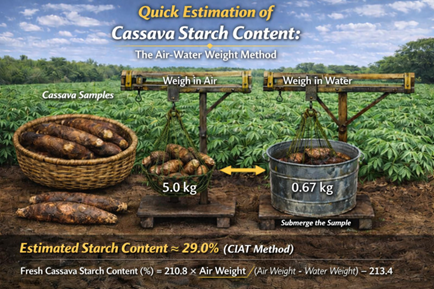
Figure 1. Air-Water Weight Method
That is where the “Air-Water Weight Method” (or water float-sink method) comes in, as shown in Figure 1. It is a low-tech, practical approach based on basic buoyancy physics. When an object is submerged in water, it displaces an amount of water equal to its own volume and appears lighter by the weight of that displaced water. Since starch is denser than water, high-starch cassava is heavier for its size, leading to different weight readings in water compared to low-starch cassava. For the same mass of a cassava root, the higher its starch content, the greater its density and the smaller its size. When fully submerged in water, it displaces less water and receives a smaller buoyant force, resulting in a smaller difference between its weight in air and its weight in water. In contrast, a cassava root with lower starch content has lower density and a larger volume. It displaces more water when submerged and receives a greater buoyant force, leading to a larger weight difference.
This method is not a replacement for lab tests—those are still needed for big trades or research. But it is over 80% accurate for quick, on-the-spot judgments. Within minutes, you can tell high-starch cassava from low-starch or check if a batch is consistent. It is an invaluable tool for grading, pricing, or deciding how to process—putting practical decision-making power directly in the hands of those at the start of the cassava value chain. As shown in Figure 2, this is a common tool in Southeast Asia for the preliminary assessment of starch content, known as the Raymond scale. Besides the Raymond scale, a common portable spring scale can also be used (See Figure 3).
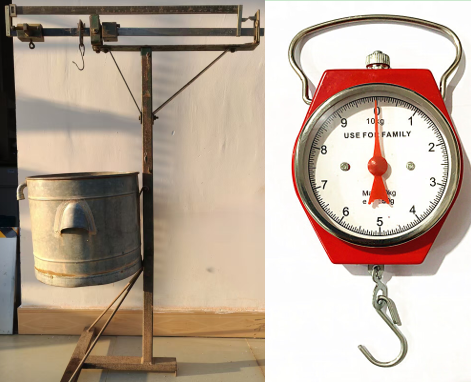
Figure 2. Raymond scale Figure 3. Portable Spring Scale
Step-by-Step Guide
Step 1: Prepare the Samples
Pick representative samples from the batch you want to test. Randomness matters—do not just choose the biggest or best-looking roots, or the results will not reflect the whole batch. Aim for about 5 kg of fresh cassava, which is enough to give reliable results.
Before weighing, use a knife to trim off excess dirt, small roots, or damaged parts (rot, bruises). There is no need to peel the roots—peeling removes starch and distorts the weight. The prepared cassava is shown in Figure 4.
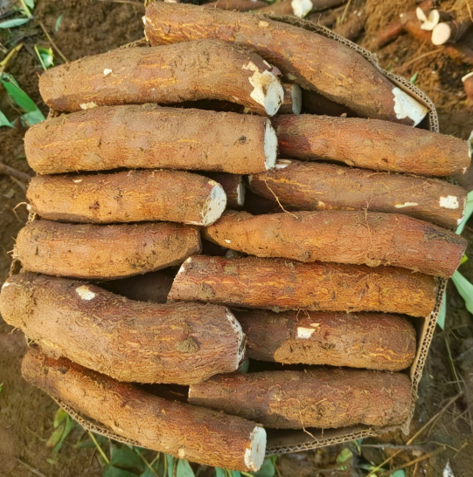
Figure 4. Prepared cassava
Step 2: Weigh the Samples in Air (Air Weight)
Hang the prepared cassava roots on the scale and write down the weight (recorded as W_air). For example, if your trimmed 5 kg sample weighs 4.8 kg, note W_air = 4.8 kg.
Make sure the scale is on a flat surface—tilting will give inaccurate readings. For mechanical scales, check that the needle is at zero before weighing. If you are testing multiple batches or varieties, label them clearly (e.g., “Batch A – Field 1”) to avoid mixing up results. As shown in Figure 5, this step is illustrated.
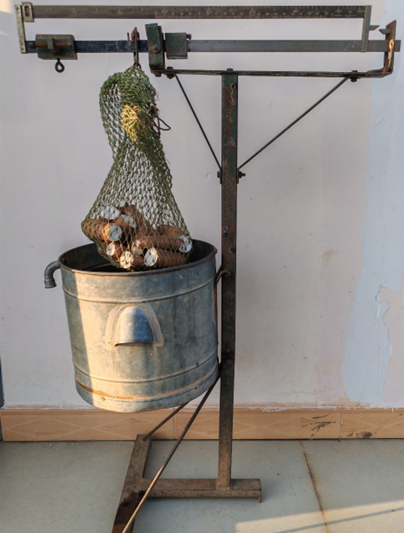
Figure 5. Weighing in air
Step 3: Calculate Starch Content
Now use water to get the second weight—follow these steps to ensure accuracy:
1. Fill the bucket or basin with enough water to fully submerge the cassava (no part should remain above the surface).
2. Put the cassava in a mesh bag or tie it with string to keep the pieces together. Gently lower it into the water until fully submerged. Important: Do not let cassava touch the bottom or sides of the container—this will make weight readings too high. Hold the string or the top of the bag to keep the cassava suspended. This set up is shown in figure 6.
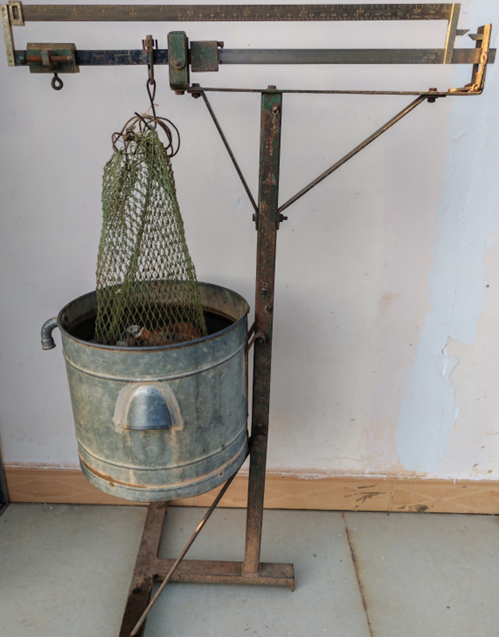
Figure 6. Weighing in water
3. With the cassava submerged and not touching the bottom or sides of the container, weigh it and record the value as W_water. For example, if it weighs 1.2 kg underwater, note W_water = 1.2 kg.
4. Use the formula from the International Center for Tropical Agriculture (CIAT):
Fresh Cassava Starch Content (%) = 210.8 × [Air Weight / (Air Weight - Water Weight)] - 213.4
Let’s use an example: W_air = 5.0 kg, W_water = 0.67 kg
- Subtract: 5.0 – 0.67 = 4.33 kg
- Divide: 5.0 ÷ 4.33 ≈ 1.15
- Multiply: 1.15× 210.8 ≈ 242.42
- Subtract: 242.42 - 213.4 ≈ 29.02%
Key Tips to Avoid Mistakes
Even simple methods require care—follow these tips to keep results reliable:
• Cassava size/shape: Avoid extremely long or irregular roots—they are more likely to touch the container.
• Water conditions: Use room-temperature water, Hot or cold-water changes density, and dirty water (with dirt or leftover starch) can contaminate samples.
• Hold hanging scales: Keep the scale steady to prevent swinging.
• Water quality: Replace the water in the bucket when it becomes cloudy, otherwise, it will lead to inaccurate results.
Applicability
This method is suitable for anyone in the Cassava Value chain—no special training required:
Who It’s For
Smallholder farmers: Check starch content before selling to negotiate fair prices; compare varieties or growing practices.
Cooperative inspectors: Quickly grade cassava into high, medium, or low starch to maintain consistent quality.
Small processors: Estimate expected yield to plan production and manage costs.
Buyers: Screen cassava during purchasing to avoid overpaying for low-starch roots.
When to Use It
After harvesting: Grade cassava from different fields to sell premium batches first.
Before processing: Estimate how much final product you will get.
For variety selection: Test new varieties to find the best performers for your farm.
Benefits and Risks
Benefits
Zero cost: Uses materials you already have—accessible even for low-income farmers.
Ultra-fast: Results in 10-15 minutes, compared with days or weeks for lab tests.
Empowers grassroots: Farmers and buyers can assess quality themselves, promoting fair trade.
Educational: Make the idea of “starch content” concrete, motivating better farming practices.
Risks and Fixes
Risk 1: Treating estimates as precise measurements, which may lead to trade disputes.
Fix: Be clear that this method is a preliminary estimate. For large transactions, rely on mutually agreed lab results.
Risk 2: Incorrect results caused by poor sampling or improper operation (e.g., cassava touching the container).
Fix: Use simple templates to cut uniform samples and follow the handling steps carefully.
Conclusion
The Air-Water Weight Method is a simple and practical option for resource-limited cassava producers and traders. It is affordable, fast and easy to use, helping fill the gap when professional tools are too expensive or unavailable. Making this method accessible enables farmers, cooperatives, and buyers to assess quality more independently, support more transparent transactions, and make informed decisions.
While not a substitute for laboratory analysis, its 80%+ reliability is generally adequate for most daily grading, pricing, and processing decisions. This method can also contribute to more efficient farm management, support small-scale businesses, and offer practical benefits across the cassava value chain. Whether you are a farmer seeking a fair price, a buyer checking quality, or a processor planning production, this method provides a practical level of reliability for everyday use.

Category
Technical Solution
Contributor
Quick Estimation of Cassava Starch Content: The Air-Water Weight Method
Country
Technical Solution