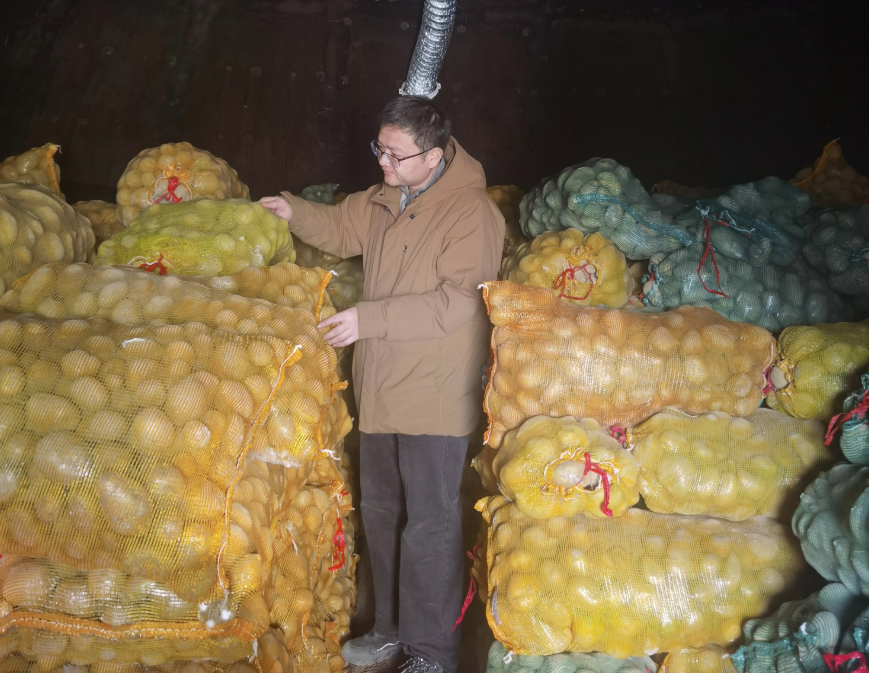
A researcher inspecting potato storage conditions in thestorage facility –Photo by Cheng Jianxin
Potatoes are a widely consumed staple in everyday diets. They play an essential role in achieving food security and increasing farmers’ income. However, potatoes have long been prone to sprouting, decay, and weight loss during storage. Combined with the high loss rates and poor-quality retention associated with traditional storage methods, these challenges have long constrained the high-quality development of the potato industry.
To ensure that potatoes can be “stored safely, stored longer, and stored well,” the research team at the Institute of Agricultural Products Storage and Processing of the Gansu Academy of Agricultural Sciences—drawing on the China Agriculture Research System (CARS-09-P26)and grounded in local production realities—has equipped the entire storage process, from harvest pretreatment to daily management, with a “technological shield,” providing strong protection for quality preservation.
Pretreatment and Environmental Control: Building a Solid Foundation for Storage
A common misconception is that potatoes can be safely stored immediately after harvest. In fact, scientific pretreatment before storage and precise environmental control throughout the storage period are not only essential steps but also the critical measures for reducing persistently high storage losses.
Pretreatment, though seemingly simple, involves important scientific principles. Freshly harvested potatoes carry field moisture and potential pathogens, and their respiration rate is extremely high. Storing them immediately is essentially“bringing pathogens into the facility,” as humidity and active physiological metabolism create ideal conditions for decay and deterioration. The proper procedure is to harvest on sunny days, allow the tubers to dry briefly in the field (avoiding direct exposure to strong sunlight), which helps dry the surface and accelerates skin suberization—a natural “protective layer” that resists pathogen invasion. If conditions permit, potatoes should be pretreated for 1–2 weeks at 13–18°C and 85%–95% relative humidity with adequate ventilation to facilitate tuber wound healing.
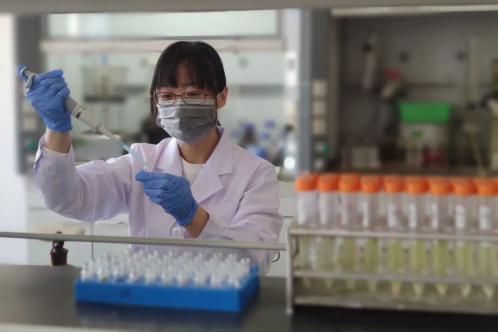
Pre-treatment for potato storage quality assessment -Photo by Tian Jiachun
Meanwhile, disinfection of the storage facility and sorting of tubers are equally essential. Before loading, disinfectants should be applied according to storage volume: 1 g/m³ peracetic acid or 0.3–0.5 g/m³ chlorine dioxide for 1–2 days of sealed fumigation, followed by 1–2 days of ventilation; or a spray of 1% sodium hypochlorite or saturated limewater, sealed for 1–2 days and followed by ventilation. If conditions allow, laying a lay of dry wheat straw or moisture proof ventilated panels on the storage floor can help block ground moisture, improve airflow, and reduce skin abrasion during tuber handling, making it a simple and practical supplementary measure. In addition, tubers must be carefully sorted, removing completely those that are severely damaged, diseased, deformed, or frost injured to prevent the chain reaction of “one rotten potato spoiling the whole storage,” a critical step in reducing post-harvest losses from the very beginning.
Compared with pretreatment, environmental control during storage is even more critical, with the core lying in the precise regulation of temperature, humidity, and gas composition. Although potatoes possess a certain degree of storability, they are highly sensitive to environmental conditions and cannot be preserved simply by “Keeping them cold”. Excessively high temperatures accelerate sprouting and decay, while temperatures that are too low can cause frost injury. Likewise, overly high humidity promotes mold development, whereas overly low humidity leads to weight loss and shrivelling. Research shows that potatoes intended for different purposes require their own “dedicated environmental regimes’. Seed potatoes are best stored at 2–4°C, which slows sprouting while preserving vigorous bud growth for subsequent planting. Table potatoes should be kept at 3–5°C to retain maximum moisture and nutritional quality. Processing potatoes, by contrast, need to be stored at 10–12°C to prevent low-temperature conversion of starch into reducing sugars and thereby ensure processing quality. In terms of humidity, all categories of potatoes are best stored at 85%–95% relative humidity to minimize weight loss. Gas concentration control is equally important: the CO₂ level in seed-potato storage should not exceed 0.2%. while that in table-potato and processing-potato storage should remain below 0.5% to prevent disorders such as blackheart.
The reason traditional storage facilities tend to have higher storage loss rates lies fundamentally in their inability to precisely regulate temperature, humidity, and gas concentrations. Low temperatures in winter can easily cause frost injury, while rising temperatures in spring accelerate sprouting, and a humid storage environment becomes a “breeding ground” for pathogens. In contrast, scientifically standardized post harvest pretreatment combined with precise environmental control during storage can effectively safeguard the first line of defence against potato storage losses and lay a solid foundation for long term, safe storage.
Facility Upgrades: Giving Potatoes a “Smart Home”
Technological innovation is enabling potato storage facilities to move beyond a “one size fits all” approach toward precisely tailored, site-specific solutions. Each upgraded facility now carries an inherent “management-friendly” advantage, lowering operational barriers, while significantly enhance storage safety.
For farmers and cooperatives in the cold, dry regions of northern China, dual control storage facilities that utilize natural cold sources have become a cost effective choice. The core innovation of this system lies in its ability to harness cold winter air through a self-developed “pressure differential ventilation and gas-regulation technology” that enables efficient cooling and dehumidification with minimal energy consumption. For storage units between 20 and 60 tons, axial-flow fans and an intelligent forced-ventilation controller can be installed to automatically regulate ventilation cycles according to preset programs, maintaining optimal storage conditions and greatly alleviating the traditional problems of uneven airflow and poor temperature control. Demonstrations in Anding District of Dingxi City of Gansu province have shown that with full uitilization of natural cold sources, potato storage losses after five months can be kept below 8%. Compared with traditional earth cellars, this approach not only significantly reduces losses but also saves substantial labor and management costs.
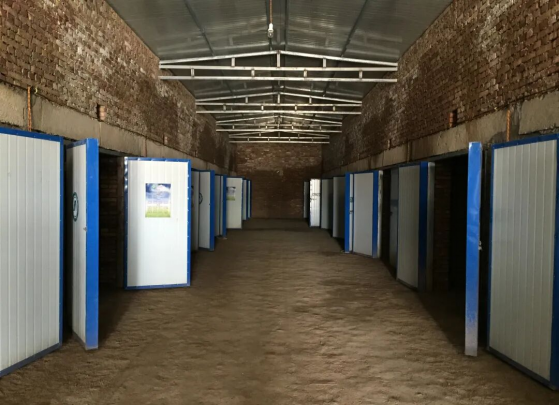
Potato storage facility – Photo by Li Shouqiang
For farmers who lack the conditions to build permanent storage facilities, the research team has developed a tailored modular storage unit made from modified graphene-enhanced expanded polystyrene (EPS). Its most distinctive feature is its modular assembly: much like building blocks, prefabricated EPS insulation modules of various shapes and sizes are fitted and bonded together, followed by an integrated waterproofing treatment. A complete storage unit can be constructed within just a few days, making the construction process highly streamlined and minimally labour-intensive.
The modular design also allows the storage unit to be adapted to user needs—for example, a compact version suitable for smallholder farmers. With a footprint of only 28 square meters and an effective interior area of 25 square meters, it can store up to 18 tons of potatoes, fully meeting the storage requirements of small‑scale operations. Performance testing of its insulation capacity shows that the modular unit is suitable for regions where winter temperatures remain above −20°C, effectively reducing the risk of freeze damage.
To further enhance usability, the modular storage unit is equipped with an internal–external circulation ventilation system that supports dual control modes: manual operation via remote switch or fully automated management through a ventilation controller. When the temperature difference between the inside and outside reaches the preset threshold, the fans activate automatically, precisely regulating internal temperature, humidity, and carbon dioxide levels while minimizing condensation. This enables truly “hands‑off” storage management, allowing farmers to maintain high‑quality potato storage without constant on‑site supervision.
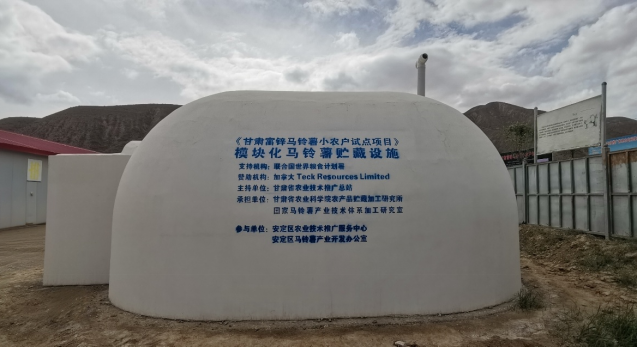
Modular potato storage facility – Photo by Cheng Jianxin
For large cooperatives, commercial-scale production bases, and processing enterprises, integrated constant-temperature storage facilities that combine mechanical refrigeration with forced-air ventilation can fully meet the demands of high-volume, high-precision potato storage. These advanced units offer a temperature control range from–5°C to 20°C, with an accuracy of ±0.5°C, and humidity control within ±3%, providing a stable and precisely regulated environment for potatoes intended for different uses. Each storage chamber is equipped with an independent ventilation system capable of switching between internal and external circulation, enabling fine-tuned operations such as preservative application during the storage period. The core advantage lies in its intelligent management capabilities: the built-in control system automatically records temperature and humidity data around the clock and generates detailed management logs. Operators can monitor storage conditions in real time through the backend system and adjust management strategies promptly whenever anomalies arise, ensuring reliable, long-term, high-quality storage of potatoes.
Preservation Technologies and Standardized Management: Accelerating Loss Reduction
If advanced storage facilities serve as the “hardware foundation” for the safe storage of potatoes, then complementary preservation technologies and standardized management procedures constitute the “software core” for achieving efficient loss reduction. When this hardware and software are fully integrated, the storage duration of potatoes can be extended to 6–8 months, and the overall loss rate can be precisely controlled below 8%, which brings tangible benefits to farmers.
As the natural dormancy period of potatoes comes to an end, rot and sprouting become the two major challenges in storage. Newly developed preservation technologies are now addressing these challenges at their root causes. For decay control, repeated screening and testing identified a food-grade preservative based on chlorine dioxide as the primary active ingredient. It is safe and residue-free while providing broad-spectrum antimicrobial activity. With this treatment, the decay rate after five months of storage can be kept below 8%, and weight loss remains under 3%, demonstrating strong preservation performance. The treatment also effectively reduces skin browning, helping potatoes maintain a bright, marketable appearance and improving their market competitiveness.
To address the challenge of sprouting, a tailored sprout inhibition preservation technologies suited to users of different production scales has been developed. This approach can extend the storage life of potato tubers to 6–8 months, with sprout-suppression rates consistently maintained above 90%. Residue levels after treatment remain far below national safety limits, meeting food-safety requirements. Notably, this technology offers a clear cost advantage: its treatment cost is only about half that of comparable imported products, requiring roughly USD 3 per ton of potatoes. This substantially reduces storage expenses and makes efficient preservation technology more accessible to farmers.
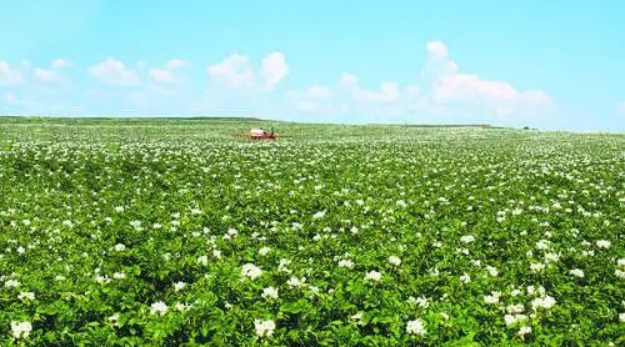
Dingxi Xiangquan township potato planting base – Photo by Chen Yonggang
While advanced technologies are important, a scientifically regulated management process is equally essential. The full storage cycle of potatoes follows a standardized sequence: harvesting and sorting → pre storage curing → graded loading → process management → timely unloading. Each step contains critical measures for reducing losses. During harvest, mechanical injury needs to be avoided to minimize potential entry points for pathogens. In the pre-storage stage, tubers need to heal surface wounds in an environment maintained at 13–18°C, which strengthens their natural protective barrier. After loading, potatoes should be stored separately according to variety, intended use, and grade to prevent interactions that may affect quality. Throughout the storage period, temperature, humidity, and tuber condition require regular monitoring, with ventilation adjusted when necessary. Before potatoes enter or leave storage, a “temperature -buffering” procedure needs to be carried out, raising or lowering the temperature by 0.5–1°C per day to prevent condensation caused by abrupt temperature changes, which can lead to skin moisture and subsequent mold development.
Not only that, but to help farmers quickly learn the more complex management steps, the research team developed easy to remember technical guidelines, illustrated posters, and training videos. With this standardized process in place, the loss rate after 150 days of storage can be reduced to 6%–8%, more than 40% lower than that of traditional pit storage.
From the past practice of relying mainly on experience for relatively simple potato storage to today’s use of standardized, science based management, the way potatoes are stored has changed considerably. These small, practical techniques and fine-tuned procedures provide effective solutions to the major challenges farmers face, helping ensure that each potato is in good condition on its journey from the field to the table and maximizing the value of agricultural production.
(Author:Ge Xia, Researcher, Institute of Agricultural Products Storage and Processing, Gansu Academy of Agricultural Sciences, China)
Related links:
2. A Practical Post-harvest Loss Management Solution from China
3. WFP Zinc-Enriched Potatoes Project in Gansu Province

Category
Integrated Technologies for Potato Storage: Ensuring Quality and Reducing Postharvest Losses
Contributor
Integrated Technologies for Potato Storage: Ensuring Quality and Reducing Postharvest Losses
Country
Technical Solution