I. Technical Background
Cassava is a highly adaptable, drought-tolerant, and barren-resistant cash crop. It serves as a staple food for more than one billion people worldwide and is also an important industrial raw material. However, traditional cassava cultivation methods rely heavily on weather conditions and extensive field management practices, resulting in low and unstable yields. To address these challenges, the technology presented in this article provides a systematic and standardized cultivation management process covering the entire production cycle—from site selection to harvesting. It effectively improves cassava yield and quality, reduces costs while enhancing efficiency, and offers technical support for the large-scale and industrialized development of cassava cultivation.
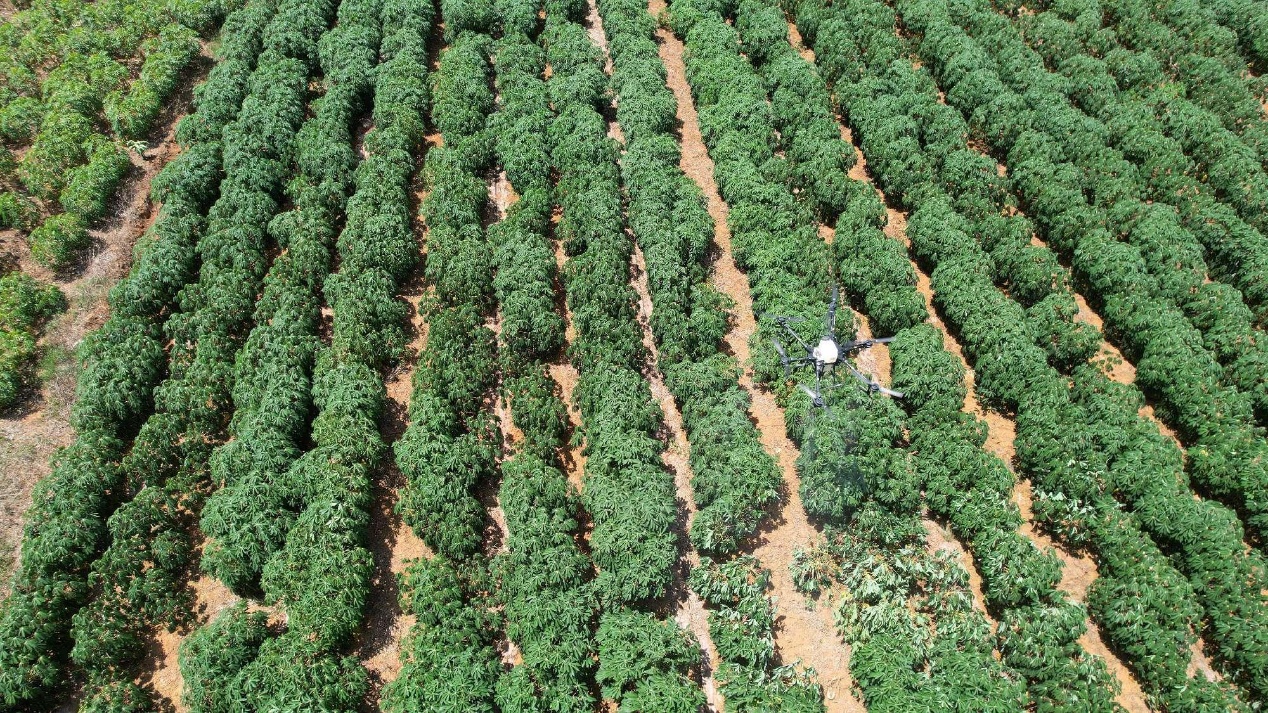
Figure 1. Weed‑free rows and uniform seedlings under high‑yield practices
II. Operation Steps
The technology is divided into four core stages: pre-planting preparation, planting procedures, post-planting management, and harvesting and storage of seed stems.
(I) Pre-planting Preparation
1. Site selection and land preparation
Select land with good drainage, deep soil layers, and moderate to high fertility, with a soil pH value of 4.5-7.0. Avoid saline-alkali soil and low-lying areas prone to waterlogging. Till the soil to a depth of approximately 30 cm, followed by plowing and harrowing to loosen and refine the soil. Depending on the terrain, adopt appropriate land preparation methods:
• Terraced fields are suitable for slopes steeper than 15 °.
• Gentle slopes below 10 ° can be tilled using machinery.
• Hilly and mountainous areas may use animal-drawn plowing or open-circuit planting.
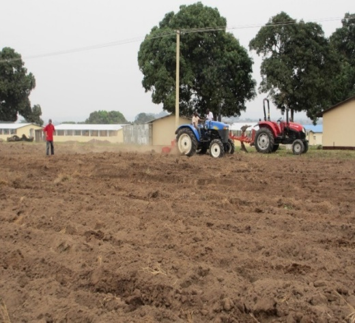
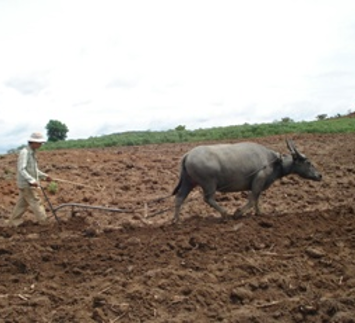
Figure 2. Field soil layer management
2. Seedling screening and treatment
Screening: Select healthy stem segments from the middle to lower parts of the main stem. Choose segments that are fully mature, robust and densely structured, with a well-developed pith, intact bud points, and no signs of pests or diseases.
Cutting: Use a sharp knife or saw to cut the seed stem into 15-20 cm segments, ensuring smooth, clean cuts to avoid skin damage or bud injury.
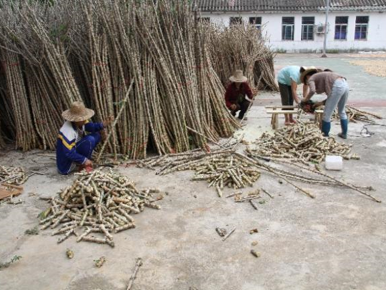
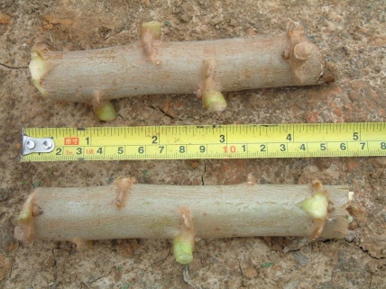
Figure 3. Stem screening and treatment
(II) Planting Procedures
1. Planting method
1.1 Artificial planting: One of the following methods may be selected based on field conditions:
(1) Horizontal placement: The planting hole is 5-8 cm deep. Place the tuberous stem horizontally and cover it lightly with soil. This results in shallow tuber formation, making harvesting easier.
(2) Tilt planting: Insert the seed stem at a 15–45° angle to the ground, leaving one-third of the stem above the soil surface. This method promotes rapid emergence and concentrated tuber formation.
(3) Direct planting: Insert the seed stems vertically into the soil. Plants show strong drought and wind resistance, but harvesting is relatively difficult.
1.2 Mechanized planting: Use specialized machinery to complete processes such as trenching, stem cutting, sowing, and soil covering in a single operation, ensuring high efficiency and low costs.
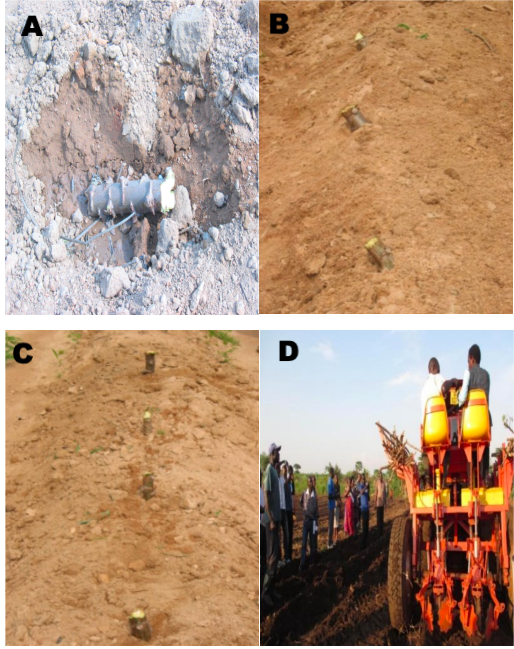
Figure 4. A. Horizontal placement; B. Tilt planting; C. Direct planting; D. Mechanized planting
2. Rational planting density
Depending on the cultivar and water-fertilizer conditions, plant 10,000-15,000 plants per hectare. Recommended row spacing is 0.8 m × 1.0 m or 1.0 m × 1.0 m, ensuring a rational canopy structure with good ventilation and light penetration.
(III) Post-planting Management
1. Seedling replacement
Approximately 20 days after planting, promptly replant missing hills with spare seed stems or seedlings to ensure full stand establishment.
2. Thinning
When seedlings reach 15-20 cm in height, retain 1-2 healthy seedlings per hole and remove weak or excess plants.
3. Weeding
(1) Tillage and manual weeding: Conduct inter-row tillage and weeding at 30-40 days, 60-70 days, and 90-100 days after planting.
(2) Chemical weed control: Before seedling emergence, apply a mixture of "isopropyl acetamide" (pre-emergence herbicide) and "glufosinate" (post‑emergence/contact herbicide) to effectively control early-stage weeds.
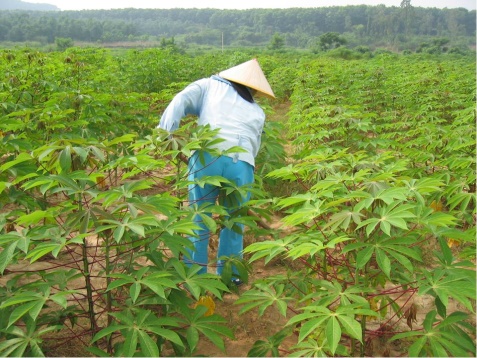
Figure 5. Tillage and manual weeding
4. Fertilization
(1) Timing: Fertilizer should be applied one month after planting, when seedlings reach about 20 cm in height.
(2) Method: Dig holes 20 cm away from the cassava stem, apply fertilizer deeply, and cover with soil.
(3) Fertilization ratios: Different fields need different proportions of nitrogen (N), phosphorus (P₂O₅), and potassium (K₂O). For newly cultivated land or fields planted for two consecutive years of cropping, the recommended nutrient ratio is N:P₂O₅:K₂O = 2:1:2. For fields that have been planted continuously for five consecutive years, the optimal balanced ratio should be N:P₂O₅:K₂O = 3-4:1:3-4.
(4) Recommended application rate: To meet the nutrient ratios above, 15 tons of organic fertilizer per hectare can be applied, together with 100-225 kg of urea, 100-300 kg of superphosphate, and 100-250 kg of potassium chloride; alternatively, 150-300 kg of compound fertilizer (15:15:15) may be used along with 100-180 kg of urea and 100-200 kg of potassium chloride. This fertilization regimen generally ensures stable annual yields, with fresh cassava production reaching approximately 30-45 tons per hectare.
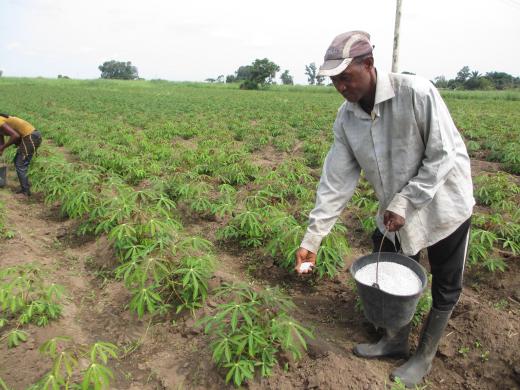
Figure 6. Fertilization
(IV) Harvest
1. Manual harvesting
Manual harvesting is commonly used in small-scale production. The entire branching structure is removed first, leaving only the main stem, which is then pulled out manually or with a tuber puller.
2. Mechanization
In mechanized cassava cultivation, the crop can be harvested using a cassava harvester, leaving about 10 cm of stem above ground. The remaining stems should then be completely cut, or the cassava stalks can be crushed with a straw shredder before harvesting directly with the harvester.
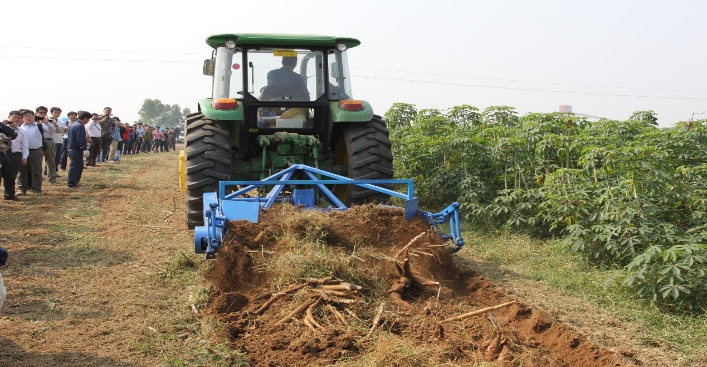
Figure 7. Mechanical harvesting
III. Analysis of Key Processes
(1) Soil preparation quality is fundamental: deep plowing and meticulous land preparation create a loose soil environment that directly influences the expansion space for tuberous roots and the final yield. In mountainous areas, soil-and-water conservation is essential for preventing soil erosion and ensuring sustainable production.
(2) Seed stem quality is paramount: as the starting point of plant growth, the stored nutrients and vitality in seed stems directly determine germination rate and seedling vigor. Selecting robust mid-to-lower stem segments is the first step toward achieving "full and vigorous seedling emergence."
(3) Fertilization management serves as the yield driver: Cassava is a potassium-demanding crop, as potassium plays a dominant role in root bulking. However, nitrogen and phosphorus are also essential for promoting seedling growth and the development of robust root systems. Therefore, a balanced supply of all three major nutrients is critical. Growers should adjust N-P-K fertilizer ratios flexibly according to soil nutrient status and cropping duration. Early-stage fertilization can significantly stimulate seedling growth and enhance tuber initiation, representing a key practice for achieving stable and consistently high yields of cassava.
IV. Scope of Application
This technology is applicable to cassava cultivation areas in southern China and to subtropical and tropical regions worldwide with similar climate conditions, including stable warm temperatures, adequate rainfall and extended frost-free periods. It is suitable for growers of all scales, from small family farms to large-scale commercial plantations, and can be implemented manually or mechanically depending on local production conditions.
V. Benefits and Risks
1. Benefits
(1) Economic benefits: Through standardized management, it is estimated that the yield of fresh cassava can reach 30-45 tons per hectare, representing an increase of about 20% compared with traditional cultivation methods. Mechanized planting can also significantly reduce labor costs.
(2) Ecological benefits: Scientific soil management and soil-and-water conservation measures help reduce ecological damage. The rational application of chemical weed control, combined with inter-row tillage, can create biological ground cover, thereby conserving soil moisture and enhancing fertility.
(3) Social benefits: Enhancing the standardization of cassava production provides stable and high-quality raw materials for the processing industry and promotes the healthy development of the entire industrial chain.
2. Risks and responses
(1) Climate risk: Climate variability remains one of the major risks in cassava production. Climate conditions such as low temperatures, drought, or flooding can affect seedling emergence and subsequent growth. These risks can be reduced by selecting varieties with strong adaptability to local conditions and by preparing appropriate drainage and irrigation facilities.
(2) Market risk: Market fluctuations in fresh cassava prices may affect farmers’ returns. To reduce exposure to price volatility, farmers can establish purchase agreements with processing enterprises to secure stable sales channels. Where storage conditions allow, fresh cassava may be stored temporarily to avoid selling during low-price period and help mitigate these market-related risks.
(3) Technical implementation risks: These risks may arise when fertilization ratios are not applied correctly or when herbicides are used in a non-standard manner, potentially leading to reduced yield or phytotoxicity. The recommended response is to strengthen technical training and guidance for growers to ensure the precise implementation of all measures.
VI. Conclusion
This high-yield standardized cassava cultivation system provides farmers with a practical and reliable technical solution to boost cassava productivity. It integrates full-cycle procedures, including land preparation, high-quality seed stem screening, rational planting density, targeted field management and harvest management, into a coherent technical package. Centered on potassium-focused balanced fertilization, refined soil preparation and the effective use of robust seed stems, the system ensures stable and consistent tuber yields across diverse farming environments.
Widely adaptable to tropical and subtropical regions with similar agroclimatic features, this technology performs equally well for smallholder farmers and large commercial plantations. Growers may choose manual or mechanical operations according to their production capacity, greatly expanding its potential for widespread adoption. Nevertheless, several potential hazards remain, including extreme weather, volatile market prices, and nonstandard fertilizers and herbicides application. These risks can be effectively mitigated by planting stress-tolerant cassava varieties, signing long-term supply contracts with processing enterprises, and providing regular technical training for practitioners.
In summary, this cultivation framework serves as a replicable and scalable paradigm for modern cassava farming. It increases land productivity, reduces overall production costs, conserves cultivated land resources, and supplies stable, high-quality raw materials for downstream processing sectors, thereby promoting the long-term sustainable development of the global cassava industry.

Category
Technical Solution
Contributor
High Yield Cassava Cultivation Techniques
Country
Technical Solution