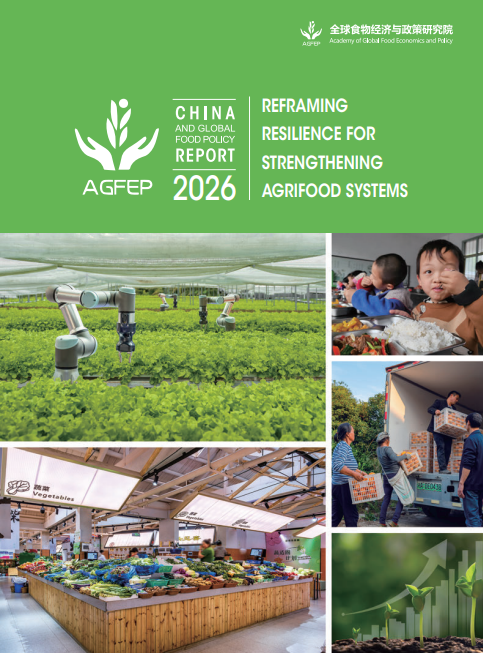
 The 2026 China and Global Food Policy Report (English version) was released on July 10th. Under the theme" Reframing Resilience for Strengthening Agrifood Systems," this year's report examines agrifood systems resilience under rising uncertainty, analyzing how climate, geopolitical, biological, and market shocks shape production stability, supply chain reliability, and nutrition security. It identifies core vulnerabilities across the value chain and proposes integrated resilience pathways that strengthen risk preparedness, enhance storage‑logistics capacity, improve consumer‑side nutrition protection, and advance coordinated fiscal‑financial support to safeguard food security and sustainable development.The report is led by the Academy of Global Food Economics and Policy, with contributions from partner institutions.
Key Findings
1. Divergent Production Resilience in China: Macro Stability and Structural Imbalances
· National Agrifood Output Exhibits Stability but with Underlying Provincial Disparities and Non-staple foodsvolatility. While national agricultural output remains remarkably stable, fluctuating within a narrow 1 to 4 percent band, volatility amplifies significantly at the provincial level, ranging from 7 to 35 percent. Grain output varies by a mere 1.54 percent, underscoring its role as a ballast for stable supply. In contrast, non-grain categories exhibit far greater vulnerability, with year-on-year standard deviations for pork, oil crops, fruits, and aquatic products reaching 14.7, 20.2, 28.25, and 34.52 percent respectively.
· Dietary Energy Stability Masks Lurking Macronutrient Volatility in Nutrients Supply. While energy and carbohydrate supplies have maintained smooth trajectories, proteins and fat supplies exhibit relatively pronounced fluctuations. Exogenous shocks such as the COVID-19 pandemic exacerbated volatility after 2020, and no persistent downward trend has emerged overall.
· Grain prices remain stable but volatility in animal products and cash crops continues. Grain prices have remained largely stable owing to policy interventions, whereas animal product prices exhibit drastic volatility, with peak year-on-year fluctuation in pork prices reaching 55.7 percent. Similarly, the price volatility of cash crops significantly exceeds that of staple grains, starkly revealing the structural imbalance inherent in the production resilience of the agrifood systems.
2. Rapidly Evolving Resilience of Intermediate Links: From Accumulation and Enhancement to Structural Consolidation
· Low Resilience Phase (2013-2018). During this period, the resilience index for intermediate links fluctuated within a narrow band of 0.45 to 0.52, indicating a uniformly weak profile. This stemmed primarily from foundational deficits in cold storage and freight capabilities, compounded by elevated import exposure.
· Enhancement Phase (2018-2022). The index surged from 0.48 to 0.63, propelled by the rapid expansion of warehousing, logistics, digital retail, and emergency response systems. This acceleration was driven by responding to the exigencies of the COVID-19 pandemic and sustained public investment in food security.
· Structural Consolidation Phase (2022-2024). The index fluctuated within a tight range of 0.68 to 0.70, signalling a structural consolidation. The marginal pullback observed in 2024 likely reflects the dual challenges of diminishing marginal returns on policy interventions and mounting geopolitical risk pressures.
3. Nutrition Resilience Divide: Intra-Household Gaps and the Policy-Outcome Disconnect
· Individual Nutrition Resilience Remains the Blind Spot of Household-Centric Metrics. Traditional indicators of nutrition resilience, such as the Household Dietary Diversity Scor e (HDDS), implicitly assume equitable resources distribution among household members. Inreality, intra-household allocation reveals far greater complexity, marked by persistent inter-generational and gender disparities. Data indicates that among low- and middle-income families, the elderly aged 75 and above and women exhibit notably lower Dietary Diversity Scores (DDS). This inequity is particularly acute in rural households with left-behind or solitary elderly members.
· A Decoupling of Well-Established Institutions and Lagging Policies. China has established distinct institutional strengths in basic security and emergency response. During major crises such as the COVID-19 pandemic, the government demonstrated institutional efficacy and coordinated resilience through efficient resource mobilization and targeted policy deployment. However, the policy focus lags behind the evolving nature of risks. Crucially, the intra-household allocation mechanism, a critical mediator linking household resources to individual nutrition outcomes, has yet to be prioritized in policy design.
4. Simulations Scenarios Uncover Potential Perfect-Storm Dynamics and Systemic Vulnerability
· Climate Change Scenario Reveals Systemic Shocks to China’s Agrifood production. These shocks trigger cascading economic disruptions and nutrition losses. Output of staple grains, fruits and vegetables, and livestock and aquatic products is projected to decline by 3.5 to 8 percent, 0.8 to 1.5 percent, and 1 to 3 percent, respectively. Reduced supply triggers significant price divergence: grain prices surge by 8 to 26 percent for rice and wheat, and 17 to 34 percent for corn, while meat prices rise by 2 to 4 percent. Consequently, grain imports are expected to increase by 3.4 to 6 percent. The shock propagates along the industrial chain, leading to an approximate 1 percent contraction in overall GDP, with agricultural GDP dropping by 1.2 to 2.6 percent, and output in food processing and the hospitality and catering sectors sliding by about 2 percent. Climate change also curtails the availability of macronutrients, including energy, protein and fat, by roughly 2 to 3 percent.
· Pest and Disease Outbreaks Trigger Localized Supply Contractions and Moderate Macroeconomic Spillover. Grain and horticultural outputs fall by 0.2 to 5 percent and 0.16 to 4 percent, respectively. Price increases of 1 to 12 percent for grain and 0.5 to 11 percent for vegetables remain milder than those under the climate scenario, with grain imports rising by 0 to 2 percent. Rising input costs amid uncertainty suppress consumer demand and output in agriculture, food processing, and hospitality, weighing on overall GDP. Pest outbreaks reduce energy supply by 1 to 2 percent, and curb protein and fat supplies by 2 to 3 percent and 3 to 5 percent, respectively.
· Animal Disease Scenario Leads to Concentrated Supply Contraction and Market Turbulence, with Macroeconomic Impacts Largely Contained. Output of livestock and aquatic products decreases by 0.12 to 3 percent and 0.2 to 5 percent, accompanied by significant price hikes of 0.2 to 7 percent. Domestic supply gaps lead to a marginal increase in meat imports, with a median rise of 0.2 percent. While the macro-level impact on overall GDP is limited, the food industry and catering sector suffer notable negative effects. Animal diseases cause protein and fat supplies to drop by 2 to 3 percent, alongside a slight dip in energy supply.
· Geopolitical Conflict Elevates Global Agrifood Costs from Hormuz Disruptions, and Domestic Production Impacts Remain Contained. This is primarily because China’s fertilizer and pesticide industries are dominated by domestic production and sales, insulating them from international price volatility. Fluctuations in agrifood output and prices are relatively mild, ranging from 0.02 to 0.2 percent, import volumes remain stable and the impact on both the agrifood system and the national economy is constrained. Effects on nutrient supply are also minimal, staying within a 1 percent threshold.
· Intertwined Crises Scenario Delivers a Systemic Blow to China’s Agrifood Systems, Constituting a Potential Perfect Storm. Grain output falls by 4 to 14 percent, fruits and vegetables by 1 to 7 percent, and livestock and aquatic products by 1.5 to 10 percent. Prices climb sharply: grain by 13 to 47 percent, vegetables and fruits by 0 to10 percent, and animal products by 2 to 14 percent. Grain imports rise by 3 to 8 percent. Due to cost escalations, the GDP of agriculture, food processing, and services all decline by 5 to 6 percent, dragging down overall GDP by approximately 2 percent. The impact on nutrients supply is also severe, with dietary energy, protein, and fat availability dropping by 5 to 10 percent.
· External Shocks Erode Nutrition Resilience Primarily Through the Cascade Effect of Reduced Affordability. This chain reaction follows a clear sequence: income decline leads to reduced food expenditure, which triggers downgraded nutrition consumption. This is exacerbated by ineffective substitution due to a lack of nutrition knowledge, resulting in disproportionate nutrition loss among vulnerable household members. Such shock-triggered chain reactions manifest most completely and typically in vulnerable households, including low-income families, rural residents, and migrant populations.
5. Resilience Building Effectively Mitigates External Shocks to the Agrifood Systems
· Simulation Results Confirm that Resilience Measures can Significantly Mitigate the Impact of External Shocks. Traditional emergency management focused solely on bouncing back, or restoration, proves inadequate for addressing irreversible compound risks. Agrifood systems resilience must pivot toward bouncing forward, shifting from passive post-shock recovery to leveraging shocks as catalysts for structural adjustment, thereby achieving synergy among resistance, recovery, and transformation.
· Production-Side Interventions Prove Effective. Integrating high-standard farmland construction with stress resistant breeding could narrow grain output declines under climate change scenarios from 3.5 to 8 percent down to 0.5 to 3 per cent, while curbing price surges to 2 to 12 per cent. Advanced pest control technologies could reduce crop losses from 0.2 to 5 percent down to 0.1 to 2 per cent, lessening import dependency. Furthermore, vaccine R&D and mandatory immunization could limit output drops in livestock and aquatic products to within 0.6 percent, preventing drastic price fluctuations in pork and other commodities. Although comprehensive measures cannot fully offset systemic shocks, they can narrow the overall GDP decline from 2 to 1 percent and keep losses in dietary energy, protein, and fat supplies below 2 percent, significantly bolstering the nutrition security resilience.
· Enhanced Intermediate Links Efficiency Underpins Overall Resilience. China’s agricultural logistics infrastructure is shifting from simply expanding storage expansion toward a dual focus on circulation efficiency and post-harvest losses reduction, laying a crucial foundation for systemic resilience. Regarding grain distribution, a cross-regional circulation pattern characterized by the North-to-South and Central-to-West Grain Transportation3 has taken shape. Railways, waterways, and highways account for approximately 50, 40, and 10 percent of inter-provincial transport volume respectively, reflecting a maturing multimodal transport system. Concurrently, national grain storage capacity continues to expand, the storage structure is being optimized, and the coverage of emergency reserve, transport, and distribution networks has expanded significantly.
· China’s Multi-Tiered Protection Framework Strengthens Nutrition Resilience. China’s framework is anchored by social assistance as the foundation, food security strategies as the backbone, and targeted nutrition interventions as supplements. According to National Development and Reform Commission (NDRC), in response to the COVID-19 pandemic in 2020, the government issued CNY 19.09 billion in temporary price subsidies, benefiting 310 million person-times. By the end of 2022, a nationwide grain emergency network covering both urban and rural areas had been established, with emergency processing capacity sufficient to meet the nation’s basic needs for approximately two days.
· Financial and Fiscal Support Delivers Tangible Resilience Dividends. The agrifood systems exhibit significant public goods attributes. Given the market’s insufficient provision, a collaborative framework is required, characterized by fiscal funds providing steering, financial instruments offering empowering, and social capital participating. China has preliminarily formed a multi-tiered support system: by the end of 2025, the outstanding agriculture-related loans reached CNY 53.6 trillion, and agricultural insurance premiums totalled CNY 155.5 billion, cementing China’s position as the world’s largest agricultural insurance market. Innovative instruments such as rural revitalization bonds, green credit, and supply chain fi nance continue to emerge, while pilot programs for models like Insurance Plus Futures and blended fi nance have demonstrated tangible results.
6. However, Short-Term Relief Measures Can Undermine Long-Term Agrifood Systems Resilience
· Agrifood Systems Resilience Entail Dynamic Evolution Through Three Capabilities, No Reversion to the Pre-Shock Status Quo. The system evolves dynamically by the progressive layering, mutual reinforcement, and synergistic development of resistance, recovery, and transformation. Upon impact, the agrifood system first leverages resistance to cushion the shock and r each its bottom. It then deploys recovery to restore functionality. Ultimately, structural transformation enables the system to bounce forward, transitioning toward efficient and sustainable long-term resilience.
· Emergency Interventions Entail Significant Long-Term Risks Despite Their Short-Term Necessity. Research indicates that amid emergencies such as food crises, pandemics, or geopolitical conflicts, governments often resort to stop-gap measures, including subsidies, price supports, and trade protectionism. While these measures rapidly block crisis transmission, stabilize market expectations, and protect vulnerable groups, they carry significant risks. Failure to exit such measures timely or poor design breeds path dependency and market distortions, inflicting deep-seated damage on the long-term industrial structural optimization and competitiveness cultivation.
Policy Recommendations
1. Production Side: Building a Resilience System for Front-Loaded Risk, Stabilized Capacity, and Green Adaptation
· Strengthening Ex-Ante Prevention. Dismantle data silos across meteorology, plant protection, water resources, credit, and insurance to establish an integrated, categorized early warning system for regions, product types, and disaster types. Prioritize resources allocation to major grain-producing areas, medium- and low-yield farmland, and climate risk-exposed regions. Accelerate the construction of high-standard farmland, irrigation and drainage facilities, and pest monitoring stations, while refining emergency reserve and deployment mechanisms for critical inputs such as seeds, fertilizers, feed, and vaccines, to ensure these resources are accessible, rapidly deployable, and readily usable when crises strike.
· Facilitating Post-Disaster Recovery. Establish robust mechanisms for replanting, cross-regional machinery dispatch, and production-marketing coordination. Enhance mandatory immunization, non-hazardous disposal, culling subsidies, and restocking support for livestock. Improve policy synergy among agricultural catastrophe insurance, agricultural insurance, disaster relief, and credit support, while establishing green channels to improve claims settlement targeting smallholders, small-to-medium farms, and remote areas.
· Promoting Resilience Transformation. Concentrate R&D on crop varieties resistant to droughts, waterlogging, pests, and diseases, as well as high-nutrition varieties, bolster ed by germplasm protection. Promote green pest control, and intelligent monitoring to gradually replace high-intensity chemical use and reduce non-point source pollution. Link subsidies, credit, and insurance directly to water and fertilizer reduction, eco-friendly farming, and diversification. An Agricultural Resilience Development Fund should be established. By leveraging policy loans, special bonds, and technology vouchers, the government can guide private capital to participate in upgrading agrifood systems resilience.
2. Intermediate Links: Establishing a Resilient Network for Seamless Flow, Ample Capacity, and Highly Responsive Operations
· Weaving Dual Network of Domestic Nodes and International Corridors. Bolster the multi-tiered reserve system of central, regional, and community hubs, prioritizing breakthroughs in deploying fresh and short-shelf-life foods. Layout overseas warehousing and transshipment facilities in major grain-producing regions and at critical shipping nodes to mitigate chokepoints risks associated with key hubs like the Strait of Malacca and the Strait of Hormuz. Develop intelligent multimodal dispatch platforms and automate alternative routing to ensure the cross-regional allocation of grain, oil, and fresh products.
· Enhancing Dual Capabilities for Peacetime and Emergency Response. Guide enterprises to maintain dual inventories and adopt modular, digital lines to achieve seamless conversion to emergency food production. Popularize nutrition fortification technologies, e.g., fortified flour and edible oils, to prevent micronutrient degradation during emergencies. Construct a farm-to-table traceability system using transparent data to pre-empt consumer panic.
· Constructing Diversified Risk Avoidance and Rules-Based Safeguards. Diversify import sources, focusing on soybeans, oil crops, supported by a red-yellow-blue early warning mechanism. Leverage the Belt and Road Initiative to bind the supply capacity of major trading partners through technology transfer and cooperation. Advocate for green trade channels under extreme scenarios by shaping multilateral rules.
· Opening Last-Mile Connectivity and Special Safeguards. Regulate platform algorithms to prohibit big data enabled price gouging while safeguarding traditional outlets like farmers’ markets. Tackle last-mile gaps via a Platform plus Community plus Volunteers convertible distribution mechanism. Establish a normalized food voucher system for low-income groups to guarantee nutrition access during crises.
· Strengthening the Shock-Absorbing Function of Fiscal-Financial Linkages. Jointly mobilize governments, banks, insurers, and guarantee agencies for resilience financing and risk-sharing. Leverage fiscal funds to crowd-in private capital to support storage and processing entities via financing and risk transfer solutions. Integrate AI, IoT, and blockchain to secure the agrifood systems.
3. Consumption Side: Improving Resilience for Nutrition Security, Targeted Intervention, and Inter-generational Equity
· Strengthening a Nutrition-Oriented Social Support System. Redirect social security from cash subsidies to nutrition in-kind transfers. Introduce designated-use nutrition vouchers to guide low-income households toward nutrient-dense foods like fruits, vegetables, dairy, and soybean products. Optimize targeting by channelling transfers directly to primary caregivers, typically women. A three-tiered government-community-household emergency food reserve system must stockpile shelf-stable, high-protein foods and micronutrients at the community level to protect vulnerable groups, including the elderly living alone and low-income, multi-child families.
· Enhancing Dynamic Buffering Capacity Through Supply-Demand Alignment. Implement the Big Food concept to steer the agricultural supply toward nutrition diversification. Integrate dietary and nutrition education into the public health system, offering food education curricula for children and chronic disease-linked dietary guidance for middle-aged and elderly individuals to improve household food resource efficiency. Regulate the platform economy, support short-chain models such as urban agriculture, community group buying, and preserve offline channels for the elderly and less-educated groups to bridge the digital divide.
· Eliminating Structural Barriers and Bolstering Individual Nutrition Resilience. Extend the Nutrition Improvement Program for Rural Compulsory Education Students to cover preschool education. Rectify the empty calories dilemma (lacking nutrition value) in schools serving concentrated left-behind children to block the intergenerational transmission of poverty. Embed gender-priority mechanisms into employment training and entrepreneurial guaranteed loans to enhance women’s household decision-making power and nutrition access. Include community meal assistance for the elderly in basic public services, offering property tax reductions and fiscal subsidies to support central kitchens and home delivery, thereby compensating for the degradation of family care functions. Integrate data from health, agriculture, civil affairs, and statistics departments to build a household nutrition resilience monitoring system, dynamically identifying vulnerable groups and high-risk areas to achieve precise and inclusive policy delivery.
4. Fiscal-Financial Synergy: Moving Toward Empowerment and Sustainability-Oriented Innovation System
· Strengthening the Steering Role of Fiscal Expenditure. Central government transfer payments earmarked for agrifood resilience should prioritize infrastructure in central and western regions, smallholders’ capacity building, and nutrition-sensitive projects. Optimizing the subsidy structure requires shifting direct support toward resilience linked models, such as catastrophe coverage, production insurance, and green production incentives. An Agricultural Resilience Development Fund should be set up to use guarantees, risk compensation, and rewards-in-lieu-of-subsidies would effectively crowd in private capital.
· Innovating Financial and Insurance Application Scenarios. Advancing supply chain fi nance enables warehousing, processing, and logistics enterprises to utilize warehouse receipt pledges, order financing, and leasing to alleviate MSMEs constraints. Aligning climate-smart agriculture, digital supply chains, and ecological restoration with green bonds and credit facilities green fi nance support, while scaling pilot thematic bonds for agrifood resilience. Expanding integrated insurance-service pilots remains critical to incorporating catastrophe and weather index insurance into central fiscal subsidies.
· Empowering Stakeholders and Fostering Endogenous Growth. Fiscal and financial support must pivot from short-term relief to long-term empowerment, shifting focus from price interventions to a diversified architecture of direct income subsidies, full-chain insurance, and resilience financing. Crucially, clear sunset clauses and exit mechanisms are required to pre-empt protectionist path dependency and safeguard sustainable development. Confronting an age of interwoven risks and heightened uncertainty, agrifood systems resilience has transcended beyond technical fixes and reactive mitigation to emerge as a core strategic imperative. This calls for a fundamental paradigm shift, moving beyond passive mitigation to proactive stewardship, and departing from an exclusive pursuit of efficiency to a balanced framework integrating efficiency with safety redundancy. Only through such a systemic transformation can all stakeholders architect a resilient system capable of safeguarding food security, nutrition wellbeing, and socioeconomic stability.
Click here to access and download the full manual for more detailed information.
Related Links:
China and Global Food Policy Report 2025: Low-Carbon Transformation of Chinese Agrifood Systems