I. Technical Background and Overview
Traditional cassava monoculture faces challenges including low land-use efficiency, inefficient utilization of light and thermal resources, and declining biodiversity, resulting in limited economic returns and an increased risk of soil degradation. In contrast, the cassava-peanut strip intercropping system can address these challenges by establishing complementary ecological niches between the two crops. As a tall-growing crop, cassava complements the low-growing peanut through vertical spatial stratification, while their different growth durations (8-10 months for cassava vs. 4-5 months for peanut) enable staggered resource utilization over time. In addition, peanuts, as a nitrogen-fixing legume, contribute biologically fixed nitrogen to the system and help improve the soil microecological environment. Field practices have demonstrated that, through a scientifically designed spatial arrangement of the two crops, this intercropping system can effectively increase the multiple-cropping index and economic returns per unit area of dryland. It also enhances the utilization efficiency of light, temperature, water, heat, and nutrient resources while helping to alleviate the constraints associated with continuous monocropping. Therefore, the cassava-peanut strip intercropping system not only generates significant ecological and economic benefits but also provides an effective approach to promoting the sustainable development of dryland agriculture in China and other developing countries with suitable agroecological conditions.
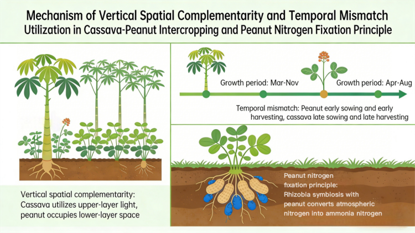
Figure 1. Schematic diagram of vertical stratification and parallel temporal complementarity in cassava-peanut intercropping
II. Implementation Measures and Procedures
1. Preparation Stage
(1) Site Selection and Land Preparation: Select gently sloping or flat land with deep soil and good drainage. Before planting, till the soil to a depth of 25-30 cm, break up soil clods and level the field, and apply sufficient basal fertilizer during land preparation. The recommended application rate is approximately 30,000 kg of well-rotted farmyard manure, 600-750 kg of compound fertilizer, and 750-900 kg of quicklime per hectare. Use machinery to form large ridges 1.4 m wide and 0.3 m high, with 0.6 m-wide furrows between the ridges.
(2) Variety Selection: Select compact, early maturing, and high-yielding cassava varieties. For peanuts, select disease-resistant, high-yielding varieties with a pearl bean type that are suitable for dryland cultivation.
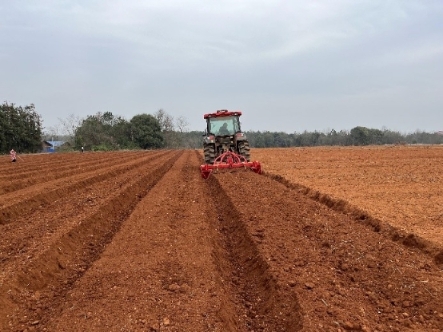
Figure 2. Mechanized land preparation
2. Operation Process
(1) Planting time: In Jiangxi Province, China, cassava is generally planted from late March to early April, when temperatures have become sufficiently warm and stable to support the sprouting and establishment of stem cuttings. As cassava cannot naturally overwinter under local conditions, it is grown as an annual crop. Peanuts are sown slightly later, from mid- to late April, when soil temperature and moisture conditions are favorable for seed germination and seedling establishment. In other regions, planting times for both crops should be determined according to local temperature and rainfall patterns, soil moisture conditions, and the crop growing season.
(2) Field configuration: A “2+3” strip intercropping system, consisting of two rows of cassava and three rows of peanut, is adopted to ensure adequate ventilation and light penetration while maintaining an appropriate planting density. Cassava and peanuts are planted on alternating adjacent ridges. On each cassava ridge, two rows are planted with a row spacing of 0.8-1.0 m and a plant spacing of 0.6-0.8 m. On each peanut ridge, three rows are planted with a row spacing of 0.3 m and a plant spacing of 0.2 m, with two seeds sown per hole.
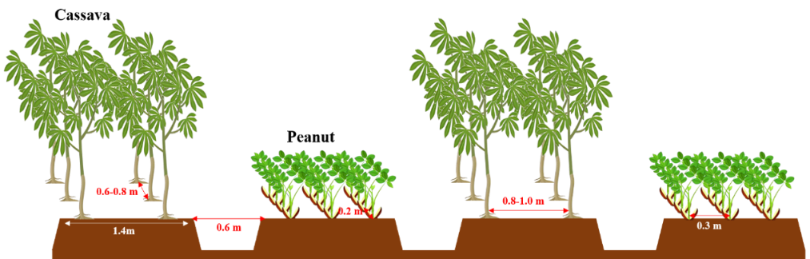
Figure 3. Schematic diagram of cassava-peanut strip intercropping system
(3) Field management: Plastic film mulching is used for cassava to suppress weeds. Cassava field management also includes selection and treatment of healthy stem cuttings;timely gap filling after emergence; thinning and removal of lateral buds from the main stem during the growing period; breaking the film to release emerging shoots and resealing the openings; supplementary irrigation during dry spells in the early growth and tuber-bulking stages while avoiding waterlogging; early topdressing with nitrogen and potassium fertilizers; and monitoring and control of bacterial wilt, cassava mosaic disease, red spider mite, mealybug and underground pests. Peanut in this intercropping system is not covered with plastic film. Weed control therefore relies on pre-emergence herbicide application, combined with repeated inter-row cultivation and hand weeding. Before row closure, soil is ridged up around the base of the plants to facilitate pegging. Appropriate growth control measures should be taken during the flowering and pegging stage, together with effective pest and disease management.
(4) Harvesting: In Jiangxi Province, China, peanut is generally harvested from mid- to late August, while cassava is harvested in late November. Harvest dates may vary in other regions depending on local temperatures and crop growth cycles. Peanuts are considered mature when plant growth has ceased, the upper leaves turn yellow and become smaller, the lower leaves wither and fall, the pod shells harden and develop distinct reticulation, and the seeds become plump and develop the seedcoat color characteristic of the variety. Cassava is ready for harvest when the tuber skin becomes darker and rough and can be easily removed by firm rubbing, above-ground growth has largely ceased, and the starch content of the tubers reaches its peak. Harvesting too early results in lower starch content, whereas delayed harvesting may increase lignification and fiber content. After the peanut harvest, peanut residues are used as mulch around the base of the cassava plants. This practice helps conserve soil moisture, suppress weeds, moderate soil temperature, reduce soil erosion, and return nutrients to the soil as the residues decompose.
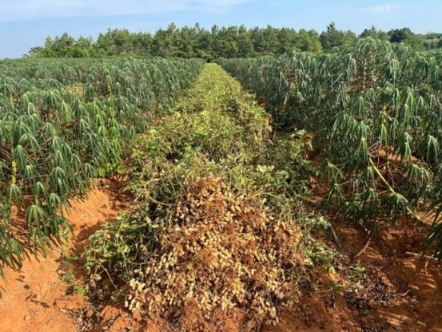
Figure 4. Peanut harvesting in a cassava-peanut intercropping system
III. Applicability Conditions
1. Applicable Region
This practice was developed under the agroecological conditions of Jiangxi Province, China, located approximately between 24°29′ and 30°04′ N latitude and 113°34′ and 118°28′ E longitude. The province has a humid subtropical monsoon climate, with a mean annual temperature of about 18°C, annual precipitation of approximately 1,600–1,700 mm, and a frost-free period of about 270 days. The practice is particularly suitable for regions with agroecological conditions similar to those of Jiangxi and may also serve as a reference for other cassava and peanut growing regions, with appropriate adjustments to local conditions.
2. Effects of Climate and Environmental Factors
(1) Temperature: Cassava requires a frost‑free period of more than 8 months and a mean annual temperature above 18 ℃, with optimal growth occurring at temperatures of 25–29℃. Cassava can tolerate temperatures ranging from 16 to 38℃; however, temperatures below 16 ℃ delay the sprouting of stem cuttings and reduce leaf production and storage-root dry weight, while temperatures above 37℃ inhibit sprouting. Peanuts generally require a mean annual temperature above 15°C and a frost-free period of at least 130 days. It should be sown only when temperatures have stabilized above 12 ℃, with optimal germination occurring at 20- 35℃. Growth slows markedly when nighttime temperatures fall below 17℃. Flowering and pegging are particularly sensitive to temperature and moisture conditions, with optimal temperatures of around 25–30 ℃. Drought during these stages can reduce pod yield by approximately 25% or more, while waterlogging mainly reduces the total number of pods and filled pods.
(2) Water Availability: Cassava is relatively drought-tolerant but sensitive to waterlogging, whereas peanuts are less drought-tolerant and have relatively higher water requirements. Cassava can be grown under a wide range of annual rainfall conditions, approximately 600–6,000 mm, although well-distributed annual rainfall of around 1000-2000 mm is more favorable for growth. Well-drained soil is essential, as flooding for even a few days during tuber-initiation and bulking can cause root rot and severe yield loss. Although cassava can produce a crop with as little as 500–650 mm of rainfall, it is particularly sensitive to soil water deficit during the first three months after planting, when drought can reduce leaf area, stomatal conductance and storage-root initiation. Supplemental irrigation during prolonged dry periods can substantially increase root yield. Peanut generally performs well under annual rainfall of approximately 500-800 mm and requires adequate moisture from flowering through pod filling, with a seasonal water requirement of approximately 400–600 mm. However, well-drained soils are essential, as excess water during maturation can delay maturity and increase pod rots and disease severity.
(3) Light: Both cassava and peanut require adequate sunlight for healthy growth. Cassava performs best under full sunlight, while peanut generally requires approximately 6–8 hours of sunlight per day.
IV. Economic Benefits and Risks
1. Production Costs and Economic Benefits
(1) Production costs: Based on 2023–2024 price levels in Jiangxi Province, total production costs are estimated at approximately USD 4,280 per hectare, including land rent, compound fertilizer, land preparation and ridging, peanut seed, plastic mulch, and labor.
(2) Yield and production value: The expected yields are approximately 3,000 kg per hectare for peanut and 30,000 kg per hectare for fresh cassava roots. Based on 2023–2024 farm-gate prices in Jiangxi Province, the total production value is estimated at approximately USD 5,570–6,000 per hectare.
2. Risks and Emergency Measures
(1) Major Risks: Market fluctuations may lead to significant volatility in crop prices, while limited market access or difficulties in selling produce may reduce farm income. Extreme weather events, such as seasonal droughts and heavy rainfall, may also result in yield losses.
(2) Risk Mitigation Measures: Contract farming arrangements can be established to secure market outlets for agricultural products. Adequate irrigation facilities should be provided to mitigate drought risks, while effective drainage systems should be maintained to remove excess water following heavy rainfall.
V. Conclusion
In summary, the cassava-peanut strip intercropping system is a simple and profitable cropping system suitable for dryland areas. Compared with cassava monoculture, the system makes better use of land and other production resources. The contrasting plant architecture and growth cycles of cassava and peanut allow the two crops to make complementary use of space and time, thereby improving overall resource-use efficiency and returns per unit area.
The system is relatively easy to implement, involving appropriate site and variety selection, suitable planting arrangements, timely weeding and field management, and harvesting according to crop maturity. The specific planting and harvesting schedules presented in this practice are based on conditions in Jiangxi Province, China, and should be adjusted according to local conditions and crop growth cycles. This system is particularly suitable for warm areas with sufficiently long frost-free periods and well-drained soil.
Although the system faces risks associated with market fluctuations and adverse weather conditions, appropriate market arrangements and water management can help reduce these risks. Developed under the agroecological conditions of Jiangxi Province, the system may provide a useful reference for farmers in other cassava and peanut growing regions, including suitable areas in Africa and other developing regions, provided that appropriate adaptations are made to local conditions.
Category
The Planting Mode of Cassava-Peanut Strip Intercropping
Contributor
The Planting Mode of Cassava-Peanut Strip Intercropping
Country
Technical Solution